
Explore India’s top Child Education Scholarship Schemes 2025 for low-income families. Learn eligibility, benefits, required documents, and application steps for SBI Asha Scholarship, CBSE Single Girl Child Scholarship, and national student aid programs.
Real-Life Story:
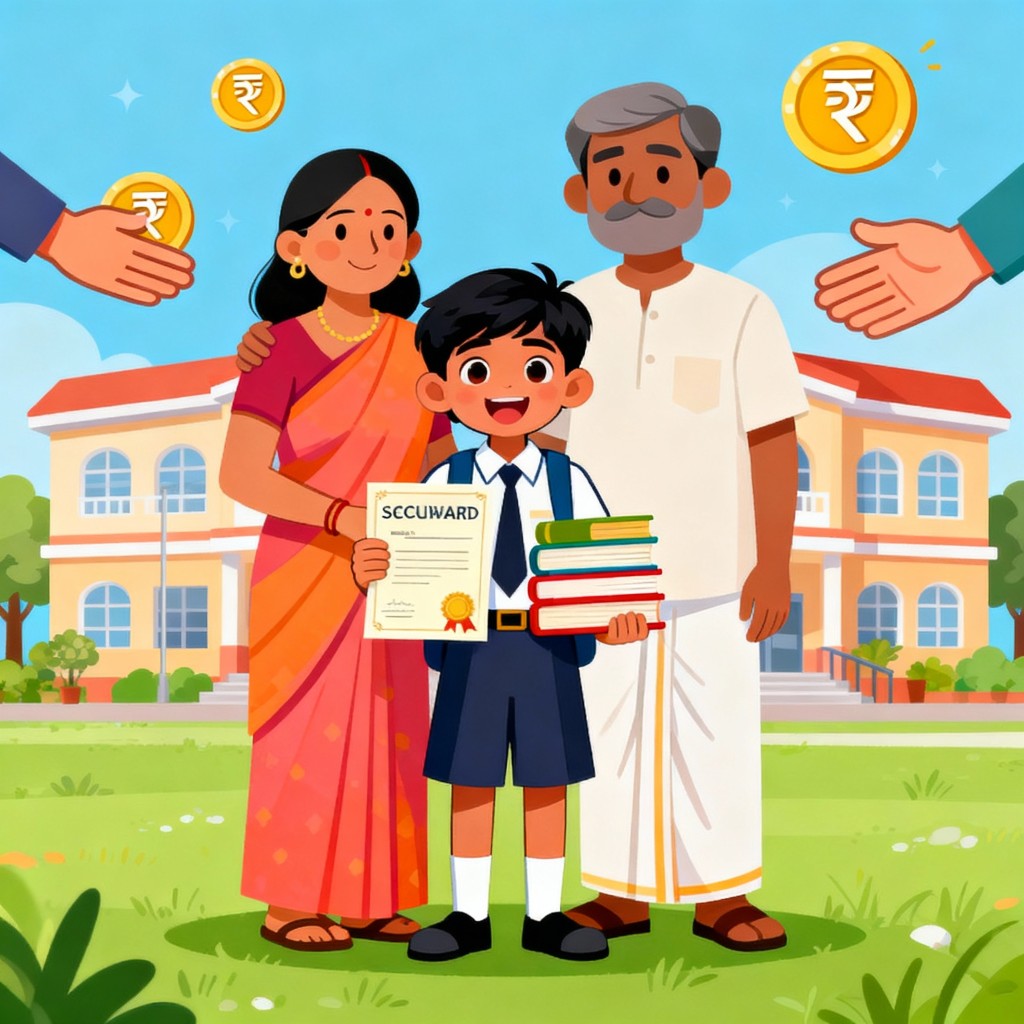
In the heart of Odisha’s Balasore district, little Ananya, a bright Class 9 student, dreamed of studying science someday but feared her father’s meagre income as a mechanic wouldn’t support her school fees. In 2024, her teacher helped her apply for the SBI Asha Scholarship, and soon, she began receiving ₹10,000 a year directly credited to her account. “When my father said, ‘You can stay in school this year,’ I felt I could finally breathe,” Ananya recalls.
Across India, thousands of children like Ananya are breaking cycles of poverty and continuing their education through the Child Education Scholarship Schemes that combine government and corporate initiatives ensuring no student is left behind because of financial limits.
Child Education Scholarship Scheme India 2025 – Overview
In 2025, the Government of India, along with public institutions and CSR organizations, offers several child education scholarships to bridge financial gaps for families earning below ₹6 lakh per year. These scholarships aim to:
- Prevent dropouts in middle and secondary schools.
- Encourage bright students from weaker sections to pursue higher studies.
- Support girl child education and gender equality.
- Provide digital, tuition, and living assistance for aspiring learners.
Some of the most impactful programs include:
- SBI Foundation Asha Scholarship
- CBSE Single Girl Child Scholarship
- National Scholarship Portal (NSP) schemes
- UGC Indira Gandhi Single Girl Child Scholarship
1. SBI Asha Scholarship 2025-26
A flagship education program by the SBI Foundation, this scheme offers annual financial help to meritorious but economically challenged students.
Eligibility:
- Indian students from Class 6 to 12, or pursuing undergraduate and professional courses.
- Minimum 75% marks in the previous exam.
- Annual family income should not exceed ₹3 lakh (for school) or ₹6 lakh (for higher education).
Scholarship Benefits:
- School students: ₹15,000 per year.
- College and university students: ₹25,000–₹20 lakh depending on course.
- 50% seats reserved for female and SC/ST students.
How to Apply:
- Visit the SBI Foundation’s education portal.
- Register with Aadhaar and mobile number.
- Upload income certificate, mark sheets, and school/college ID.
- Submit the online form before the deadline.
Ananya’s story is one among many transformed by this scholarship, helping students sustain their academic dreams.
2. CBSE Single Girl Child Scholarship 2025
Aimed at promoting education among girls, this CBSE program recognises meritorious single girl children across India and curbs school dropouts after Class 10.
Eligibility:
- Only girl child of the family.
- Minimum 60% marks in Class 10 CBSE exams.
- Studying in Class 11 or 12 in a CBSE school with tuition fees less than ₹1,500 per month (₹6,000 for NRIs).
Scholarship Benefits:
- Provides ₹500 per month for 2 years.
- Direct transfer to the student’s account.
Application Steps:
- Visit the CBSE official site and go to the scholarship section.
- Choose “Single Girl Child Scholarship 2025.”
- Register with roll number and date of birth.
- Upload mark sheet, income proof, and school certificate.
- Submit and print confirmation.
The last date for 2025 applications has been extended till November 20, 2025.
3. UGC Indira Gandhi Single Girl Child Scholarship
Introduced by the University Grants Commission (UGC), this postgraduate scholarship promotes higher education among girls.
Eligibility:
- Single girl child pursuing PG degree in a UGC-recognized university.
- Age limit: Maximum 30 years.
- Family income limit not applicable but preference is given to low-income applicants.
Scholarship Benefit:
- ₹36,200 annually for two years.
Application Method:
- Apply through the National Scholarship Portal (NSP).
- Upload Aadhaar, admission proof, and bank details.
4. National Scholarship Portal (NSP) – General Schemes 2025
NSP acts as a one-stop platform for all government-level scholarships across Ministries.
Popular Schemes under NSP:
- Pre-Matric Scholarship for Minorities.
- Post-Matric Scholarship for SC/ST/OBC students.
- Top Class Education Scholarship for EWS students.
Eligibility:
- Students belonging to SC, ST, OBC, Minority, or EWS families.
- Annual family income under ₹8 lakh.
- Must be enrolled in recognized schools or institutions.
Benefits:
- Tuition fees reimbursement (₹10,000–₹50,000 annually).
- Maintenance allowance ₹1,200 per month on average.
Documents Required:
- Income certificate and mark sheets.
- Aadhaar and bank account details.
- Caste certificate (if applicable).
Additional Scholarships for Low-Income Families
| Scheme Name | Eligibility | Annual Benefit |
|---|---|---|
| Swami Dayanand Education Foundation Scholarship | Class 12 students with 80%+ marks; income below ₹12 lakh | ₹50,000 |
| LIC HFL Vidyadhan Scholarship | Students in classes 10–PG; income below ₹4 lakh | ₹25,000–₹50,000 |
| ONGC Scholarship to OBC/SC-ST Students | Engineering, MBBS, MBA, and PG programs | ₹48,000/year |
| Kotak Kanya Scholarship | Girl students pursuing graduation in professional fields | ₹1.5 lakh/year |
Required Documents (Common for All)
- Aadhaar Card or Bonafide Student Certificate
- Recent Photograph
- Previous Year Marksheets
- Income Certificate of Parents
- Admission Proof or College ID Card
- Bank Passbook
- Caste or Minority Certificate (if applicable)
Real-Life Story:
Shahid Khan, son of a tailor in Uttar Pradesh, secured 88% in his Class 12 exams. He received support from the Swami Dayanand Scholarship to study engineering at a government college in Lucknow. “I was almost ready to drop my seat because of the fees,” he says. “That email from the scholarship foundation saved my dream.”
How to Apply for Child Education Scholarships
Step 1: Visit the official website of the desired scholarship (NSP, CBSE, SBI Foundation).
Step 2: Register with basic details and verify via OTP.
Step 3: Complete the online application form.
Step 4: Upload scanned copies of mark sheets, Aadhaar, and income proof.
Step 5: Submit before the application closing date.
Most programs disburse funds directly into students’ accounts via Direct Benefit Transfer (DBT).
Impact & Importance
- Reduces school dropout rates among economically weaker sections.
- Promotes gender equality through single-girl and female-focused scholarships.
- Encourages skill and higher education enrolment.
- Supports India’s National Education Policy 2025 goal: inclusive and equitable education.
Call to Action
Are you a parent or student struggling to manage education costs? Don’t let financial barriers block your child’s future. Apply for a Child Education Scholarship 2025 and ensure your child stays in school with stable support and opportunity.
Visit portals like the National Scholarship Portal, CBSE, or SBI Foundation today to apply online. A few documents and one verified application could change a child’s entire educational path.
Education dreams shouldn’t depend on income — they should depend on effort. Take the first step now.
Disclaimer: This article is based on personal experience and is for educational purposes only. It does not constitute financial, investment, or legal advice. Readers are advised to do their own research or consult a qualified professional before making any financial decisions.