
Confused between mutual funds and fixed deposits? Here’s a detailed 2025 guide comparing risk, returns, tax, and liquidity — with real stories, tables, and smart tips to choose what’s right for you.
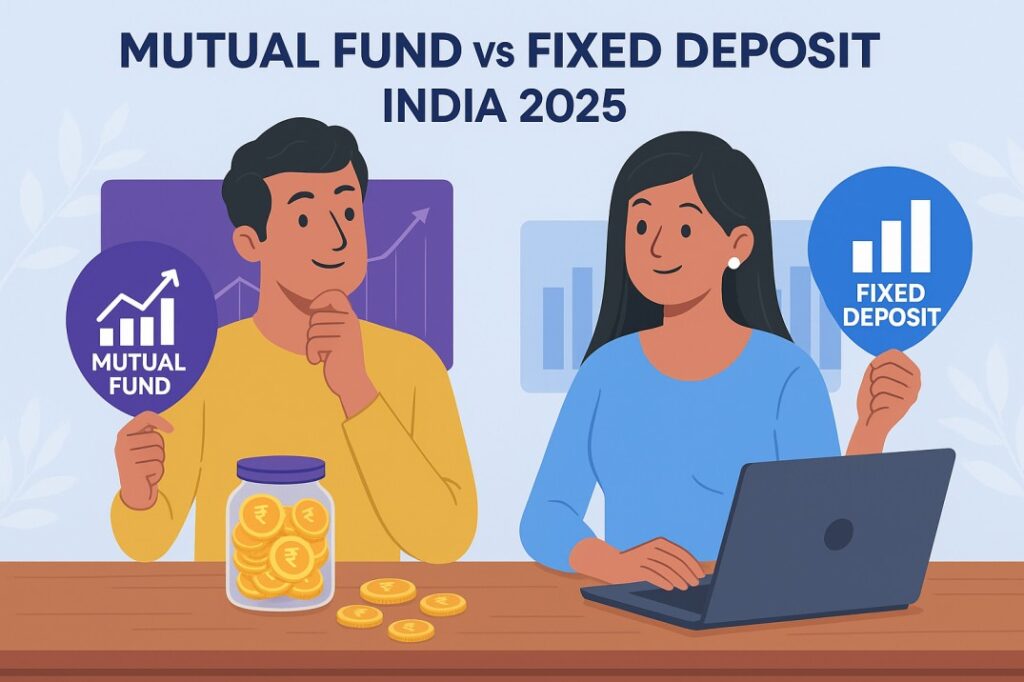
💸 Mutual Fund vs Fixed Deposit – Which is Better in India 2025?
In India, Mutual Funds and Fixed Deposits (FDs) are two of the most popular ways to save and grow money.
But in 2025, the gap between them is widening — interest rates are changing, inflation is rising, and mutual funds have become more accessible than ever.
So, which one should you choose?
The short answer: It depends on your goal, risk level, and time horizon.
Let’s dive deep — with real examples, comparison tables, and a smart decision framework to help you decide which is better for you this year.
📚 Table of Contents
- FD vs Mutual Fund: The Basics
- Interest & Return Comparison 2025
- Real Story: How Arjun Doubled His FD Returns
- Safety, Tax & Liquidity Comparison
- When You Should Choose FD
- When You Should Choose Mutual Fund
- Practical Tips Before You Decide
- FAQs on FD vs Mutual Fund in 2025
- Final Thoughts + Call to Action
🏦 FD vs Mutual Fund: The Basics
Let’s start simple.
| Feature | Fixed Deposit (FD) | Mutual Fund (MF) |
|---|---|---|
| Nature | Fixed income | Market-linked |
| Return Type | Guaranteed | Variable |
| Risk | Very low | Low to high (depends on type) |
| Liquidity | Medium (premature withdrawal penalty) | High (except ELSS) |
| Ideal For | Conservative savers | Growth-focused investors |
Fixed Deposit (FD):
You deposit money in a bank or NBFC for a fixed tenure at a fixed interest rate.
Safe, predictable, and preferred by senior citizens or risk-averse savers.
Mutual Fund (MF):
A fund where many investors pool money, managed by professionals, and invested in equities, bonds, or both.
Returns vary but usually outperform FDs over time.
👉 Also read: FD vs RD – Which Is Better for Indians?
💰 Interest & Return Comparison 2025
Let’s look at current average returns (as of 2025):
| Investment Type | Average Returns (2025) | Risk Level | Lock-in / Liquidity |
|---|---|---|---|
| Bank Fixed Deposit | 6.5% – 7.5% | Very Low | 1–10 years |
| Corporate FD | 7.5% – 8.5% | Low | 1–5 years |
| Debt Mutual Fund | 6% – 8% | Low | 3–12 months |
| Hybrid Mutual Fund | 8% – 10% | Moderate | 1–3 years |
| Equity Mutual Fund | 10% – 15%+ | Moderate–High | 3+ years |
💬 In short:
- FDs offer safety and stability.
- Mutual funds offer higher returns — but come with market fluctuations.
🌱 Real Story: How Arjun Doubled His FD Returns
Arjun Patel, a 32-year-old engineer from Pune, had ₹2 lakh in a bank FD earning 6.5% interest.
After learning about SIPs (Systematic Investment Plans), he started investing ₹5,000/month in an index mutual fund.
After 3 years:
- His FD grew to ₹2.41 lakh
- His SIP investment grew to ₹2.85 lakh
“Both were safe in their own way, but the SIP gave me flexibility and better returns.”
👉 Related: SIP for Beginners – Start with ₹500
📊 Safety, Tax & Liquidity Comparison
| Parameter | Fixed Deposit (FD) | Mutual Fund (MF) |
|---|---|---|
| Principal Safety | Guaranteed | Depends on fund type |
| Returns | Fixed | Variable |
| Risk | Negligible | Market-related |
| Liquidity | Penalty if withdrawn early | Easy redemption |
| Tax on Returns | Interest taxed as per slab | Depends on fund type (LTCG/STCG) |
| Lock-in | Chosen tenure | Only ELSS has 3 years |
| Ideal For | Short-term, risk-free goals | Long-term, high-return goals |
👉 Read next: Gold vs SIP vs FD – What Should Beginners Choose?
🧾 Taxation Comparison (2025)
| Aspect | Fixed Deposit | Mutual Fund |
|---|---|---|
| Tax on Interest / Gains | Fully taxable | Depends on holding period |
| TDS Deduction | Yes (if interest > ₹40,000/year) | No TDS |
| Long-Term Holding | N/A | 10% tax after 1 year (equity) |
| Short-Term Holding | N/A | 15% tax (equity funds) |
💡 Tax tip:
If you’re in a higher income bracket, mutual funds (especially ELSS or index funds) are more tax-efficient than FDs.
🔍 When You Should Choose FD
Choose a Fixed Deposit if you:
- Want guaranteed, risk-free returns
- Need money for short-term goals (within 1–2 years)
- Are nearing retirement or prefer stable income
- Already have market exposure elsewhere
Example:
If you’re saving for your child’s school fees or an emergency buffer, FD is the smarter, stress-free choice.
👉 Helpful read: Emergency Fund – How Much Do You Need?
📈 When You Should Choose Mutual Fund
Choose a Mutual Fund if you:
- Can stay invested for 3+ years
- Are comfortable with some market risk
- Want inflation-beating returns
- Aim for long-term goals like buying a house, or retirement
Mutual funds, especially SIPs, grow your wealth steadily and compound faster over time.
👉 Also read: Mistakes to Avoid While Starting SIP
📉 Risk vs Reward (Simple Comparison)
| Scenario | FD (₹1 Lakh, 3 Years @ 7%) | SIP (₹3,000/month, 3 Years @ 12%) |
|---|---|---|
| Total Invested | ₹1,00,000 | ₹1,08,000 |
| Final Value | ₹1,22,500 | ₹1,30,700 |
| Total Gain | ₹22,500 | ₹22,700 |
| Risk | None | Moderate |
| Liquidity | Medium | High |
💬 Takeaway:
In 3 years, both perform similarly. But beyond 5 years, SIPs usually win big because of compounding.
🧭 Practical Tips Before You Decide
- Diversify: Don’t put all money in one option. Mix FD + SIP.
- Match goals to tenure: Short-term → FD, Long-term → Mutual Fund.
- Check after-tax returns: FDs are fully taxable. SIPs can be more efficient.
- Review annually: Move money between schemes if rates or markets change.
- Avoid breaking FDs early: You’ll lose interest.
👉 Extra tip: How to Save Your First ₹1 Lakh Step by Step
🙋♀️ FAQs on FD vs Mutual Fund in 2025
1. Which gives better returns in 2025 — FD or Mutual Fund?
Mutual funds generally give higher returns (10–14%) than FDs (6–7%), but with some risk.
2. Is mutual fund investment safe for beginners?
Yes, start with debt or hybrid mutual funds. They carry low risk and steady growth.
3. Are mutual fund returns guaranteed?
No, they’re market-linked — but long-term returns usually beat inflation.
4. Which is better for short-term goals?
Fixed deposits are safer for goals under 2 years.
5. Can I invest in both FD and mutual fund?
Yes, and you should! A mix balances risk and stability.
📣 Final Thoughts + Call to Action
Both FDs and mutual funds have a place in every Indian’s portfolio.
FDs give you peace of mind, while mutual funds help you grow wealth faster.
If you’re just starting out in 2025:
- Keep 20–30% in FDs for safety,
- And put the rest in SIPs or hybrid funds for growth.
💬 “Don’t choose between safety and growth — balance them.”
👉 Continue reading: How to Build Wealth Slowly in India
Disclaimer: This article is based on personal experience and is for educational purposes only. It does not constitute financial, investment, or legal advice. Readers are advised to do their own research or consult a qualified professional before making any financial decisions.