

Learn how to open a zero balance bank account in India in 2025. Check eligibility, required documents like Aadhaar and PAN, and simple online and offline step-by-step process.
When I first started working in the early 2000s, opening a savings account at a bank felt like crossing a milestone in life. Every bank executive would tell me, “Sir, you need to maintain ₹5,000 minimum balance in your account, otherwise penalties apply.” Back then, maintaining that much money just to keep the account alive felt frustrating. Fast forward to today, things have transformed. Thanks to zero-balance savings accounts, anyone—students, homemakers, daily wage workers, salaried employees—can open and operate a savings account without worrying about maintaining a balance.
In this guide, we will dive deep into how zero-balance savings accounts in India work, their features, benefits, drawbacks, and even some real-life scenarios where they make life easier. If you’re just starting your financial journey or looking for hassle-free banking, this might be the most useful financial product available.
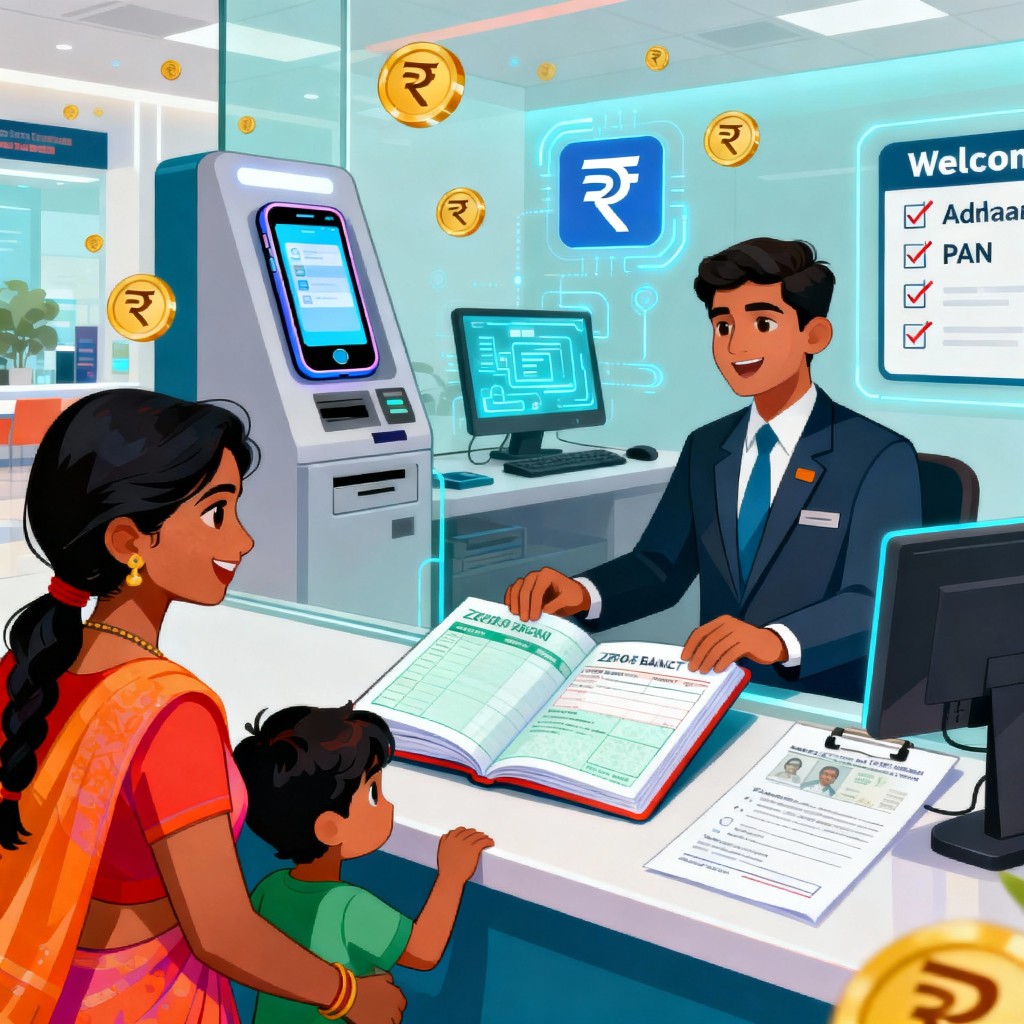
What is a Zero-Balance Savings Account?
A zero-balance savings account is like a standard savings account but with one big relief: you don’t need to maintain a minimum balance in it. That means, whether your account has ₹1,00,000 or even ₹50 at the end of the month, the bank won’t penalize you.
Most banks offer these accounts to encourage financial inclusion. They want even small-income earners, students, first-time account holders, and rural households to join mainstream banking without the fear of penalties.
My Personal Story—Why Zero-Balance Accounts Made Sense
When my cousin Ramesh moved to Chennai for his first job, his company asked him to open a salary account. Like most beginners, he didn’t have much savings. His account often dropped to ₹200 or ₹300 after meeting monthly expenses. If it had been a regular savings account, the bank would have charged him several hundred rupees every quarter as “non-maintenance of balance fees.”
Thankfully, because his salary account was a zero-maintenance account, he avoided those unnecessary charges. Over time, once his income and savings grew, he shifted to a premium savings account with perks like higher ATM limits and credit card offers. But in the early days, the zero-balance savings account was a savior.
Key Benefits of Zero-Balance Savings Accounts
- No balance worries: You’re free from the burden of maintaining minimum average balances.
- Accessible to all: Great for students, blue-collar workers, homemakers, and rural households.
- Digital banking features: UPI, net banking, debit cards, mobile banking—all are usually included.
- Salary credit convenience: Perfect for salaried employees where companies directly credit monthly salaries.
- Encourages saving habits: Even small contributors can start saving and grow financially.
Compare Zero-Balance vs Regular Savings Accounts
| Feature | Zero-Balance Savings Account | Regular Savings Account |
|---|---|---|
| Minimum Balance Required | ₹0 | ₹2,000 – ₹10,000 depending on bank |
| Penalty for Low Balance | None | ₹100 – ₹500 per month/quarter |
| Ideal For | Students, low-income earners, first-time account holders | Working professionals, people with higher balances |
| Interest Rates | 2.75% – 4% (varies by bank) | 2.75% – 4% (same range) |
| Benefits | No penalty, inclusive banking | Extra perks like higher withdrawal limits, offers |
| Maintenance Effort | Extremely low | Moderate – requires tracking balances |
Who Should Choose a Zero-Balance Account?
- Students: College goers often don’t earn steady income, so zero balance accounts are easier to manage.
- Salaried Professionals: Most salary accounts come with zero-balance features, saving employees from penalties.
- Homemakers: They can open accounts with ease to manage household savings.
- Elderly & Pensioners: Convenient for small pension deposits without worrying about penalties.
- New Bank Users in Rural Areas: A great gateway into organized finance.
Features Banks Usually Offer in These Accounts
- Free RuPay/Visa Debit Card.
- Free access to internet and mobile banking.
- Limited free ATM withdrawals per month.
- Quarterly or monthly e-statements.
- Access to UPI & digital wallets.
- Some banks also add benefits like accidental insurance cover.
Limitations to Keep in Mind
While zero-balance accounts sound great, there are a few trade-offs you must know:
- Transaction limits: Many banks cap total monthly transactions (like 3–5 withdrawals).
- Deposit limits: Maximum deposit thresholds exist for certain accounts, especially Basic Savings Bank Deposit Accounts (BSBDAs).
- Fewer perks: You may not get premium offers like airport lounge access, international debit cards, or higher withdrawal limits.
- Conversion by banks: After salary credits stop (for salary accounts), banks sometimes convert them into regular savings accounts with balance requirements.
Real-Life Example
One of my colleagues used to work for an IT company in Bengaluru. Her salary account was with a private bank, and it was zero balance. But after she left that employer, the bank started charging her for “average balance shortfall.” Why? Because the company account no longer paid her salary, and the account automatically changed its type.
This is why it’s important to check account terms carefully, especially when you open it as a salary account.
Major Indian Banks Offering Zero-Balance Accounts
Here’s a comparison of popular zero-balance accounts:
| Bank | Account Type | Key Features |
|---|---|---|
| SBI | Basic Savings Bank Deposit A/c | Free RuPay card, 4 withdrawals per month |
| HDFC Bank | Salary Account | No balance requirement, net banking, offers |
| ICICI Bank | Insta Save FD-linked A/c | Zero balance, digital onboarding, FD benefits |
| Axis Bank | ASAP Zero-Balance Account | Instant digital account, UPI, debit card |
| Kotak Mahindra Bank | 811 Digital Account | Online account opening, zero balance digital banking |
| Paytm Payments Bank | Savings Account | 2.75% interest, UPI integration, no minimum balance |
| Airtel Payments Bank | Savings Account | Linked with Airtel apps, recharge benefits |
Tips Before Opening a Zero-Balance Savings Account
- Check transaction limits: If you plan heavy use, choose one with higher free transactions.
- Look at digital features: Ensure UPI, NEFT/IMPS, and mobile app banking works smoothly.
- Insurance & perks: Some banks provide accidental cover—useful add-on.
- Salary account conversion rules: Ask your bank what happens if you switch jobs.
- Hidden charges: Watch out for debit card fees, SMS alert charges, or cheque book fees.
Frequently Asked Questions
1. Can anyone open a zero-balance savings account?
Yes, most banks allow individuals above 18 to open, and minors can open with guardians.
2. Do zero-balance accounts earn interest like regular accounts?
Yes, the interest rate is the same as that of standard savings accounts.
3. Are there restrictions on deposits/withdrawals?
Yes, some basic accounts like BSBDAs may have restrictions, generally 4 withdrawals a month.
4. Can I open multiple zero-balance accounts in different banks?
Yes, but KYC compliance applies, and banks may limit certain features.
5. What happens if I stop using my zero-balance account?
Inactive accounts may eventually become dormant after 2 years—reactivation requires a formal request.
Closing Thoughts
In today’s world, money management should be accessible to everyone—whether you’re earning lakhs per month or just starting with a few thousand. A zero-balance savings account is the simplest way to build financial discipline without the fear of penalties.
For students like Ramesh, homemakers trying to set aside grocery savings, or professionals at the beginning of their careers, these accounts act as the first stepping stone into structured money management. As savings grow, you can always upgrade to premium accounts with better perks—but until then, zero-balance accounts are your perfect financial buddy.
Disclaimer: This article is based on personal experience and is for educational purposes only. It does not constitute financial, investment, or legal advice. Readers are advised to do their own research or consult a qualified professional before making any financial decisions.