
Most Indian families don’t fail at budgeting because they lack discipline.
They fail because the system they try is too complicated for real life.
Spreadsheets feel overwhelming.
Apps get ignored after a few weeks.
And mental budgeting? That never works.
What does work — even today — is something extremely simple:
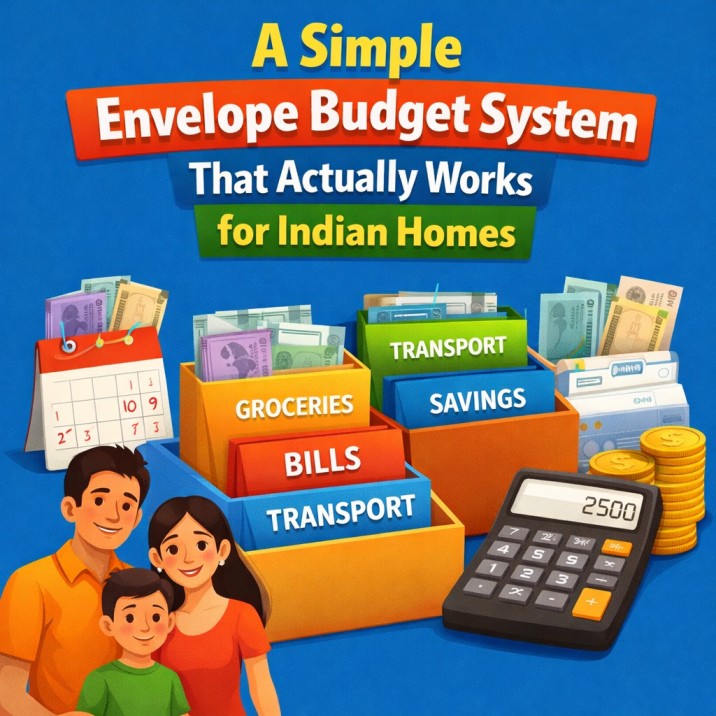
The Envelope Budget System.
No jargon.
No maths degree.
Just clear limits and visible control.
This article explains how Indian homes can use the envelope system in 2025, even with UPI, mixed cash spending, school fees, and unpredictable expenses.
Why Most Budgeting Methods Fail in Indian Homes
Indian households are unique.
We:
- Spend daily in small amounts
- Use both cash and UPI
- Support extended family
- Face frequent unplanned expenses
Most budgeting methods assume:
- Fixed expenses only
- Perfect tracking
- One income source
That’s why people quit budgeting after one month.
The envelope system works because it:
- Matches Indian spending behaviour
- Makes limits visible
- Stops overspending before it happens
What Is the Envelope Budget System (In Simple Words)
The envelope system means:
- You divide your monthly income into categories
- Each category gets a fixed amount
- Once the money in that category is finished, spending stops
Traditionally, this was done with physical envelopes filled with cash.
Today, Indian families use:
- Cash envelopes
- Bank sub-accounts
- UPI wallets
- Or a mix of all three
The principle remains the same:
Money must have a job before you spend it.
Why the Envelope System Works So Well in India
It works because it removes guesswork.
You don’t ask:
- “Can I afford this?”
You ask:
- “Is there money left in this envelope?”
That one question:
- Prevents impulse spending
- Reduces arguments
- Builds clarity for the whole family
Many families who struggled with monthly planning found clarity only after switching to simple systems, like shown in the only money system an Indian family needs.
Step 1: Decide Your Monthly Income Clearly
Start with actual take-home income, not ideal income.
Include:
- Salary after deductions
- Pension
- Fixed side income
Do not include:
- One-time bonuses
- Irregular income
Example:
- Monthly income: ₹35,000
That’s your total to divide — no assumptions.
Step 2: Create Basic Envelopes (Keep It Simple)
Don’t overdo categories.
For most Indian homes, 6–8 envelopes are enough.
Common envelopes:
- Groceries & daily food
- Rent / house expenses
- Utilities (electricity, phone, internet)
- Transport
- Education / school
- Medical / emergencies
- Savings
- Miscellaneous / festivals
Too many envelopes create confusion.
A clear monthly structure like this simple monthly budget plan with real numbers helps decide realistic amounts.
Step 3: Assign Realistic Amounts to Each Envelope
This is where honesty matters.
Example for a ₹35,000 income:
- Groceries: ₹8,000
- Rent: ₹10,000
- Utilities: ₹2,500
- Transport: ₹2,500
- School: ₹3,000
- Medical: ₹1,000
- Savings: ₹3,000
- Miscellaneous: ₹5,000
Total = ₹35,000
No guessing.
No future hope.
Only real numbers.
Step 4: Decide Which Envelopes Use Cash vs Digital
You don’t need everything in cash.
Best approach for Indian homes:
Cash envelopes
- Groceries
- Daily spending
- Small household expenses
Digital / bank-based envelopes
- Rent
- School fees
- EMIs
- Savings
This hybrid method works well in UPI-heavy households.
If overspending is a regular issue, using physical cash for groceries is especially powerful, as explained in where most Indian households lose money without realising.
Step 5: Follow One Golden Rule (Very Important)
👉 Never borrow from another envelope.
If grocery envelope finishes:
- You adjust meals
- You wait till next month
If entertainment envelope finishes:
- No more spending
Borrowing from savings or rent envelopes destroys the system.
This rule creates discipline naturally — without stress.
Step 6: Do a Weekly Envelope Check (10 Minutes)
Once a week:
- Open envelopes
- Check remaining amounts
- Adjust behaviour
Don’t wait till month-end.
Weekly checks prevent:
- Sudden money shocks
- Panic borrowing
- Arguments
This approach works better than monthly reviews, as explained in weekly budget vs monthly budget – which works better.
Step 7: What to Do If an Envelope Runs Out Early
This will happen. Don’t panic.
Options:
- Reduce spending for rest of month
- Use emergency envelope (only for genuine needs)
- Learn and adjust next month’s allocation
The envelope system improves with practice.
Perfection is not the goal — awareness is.
A Real Indian Home Example
A family of four in Indore:
- Income: ₹32,000
- Constant month-end stress
- Frequent borrowing
They started envelope budgeting with just:
- Groceries
- Rent
- Utilities
- Savings
Within two months:
- Grocery overspending reduced
- Savings envelope stayed untouched
- Family discussions became calmer
They didn’t earn more.
They just stopped money from wandering.
Common Mistakes to Avoid
- Creating too many envelopes
- Setting unrealistic limits
- Skipping weekly checks
- Borrowing between envelopes
- Giving up after one bad month
This system works when it’s simple and consistent.
How Envelope Budgeting Helps Save Automatically
Most families using envelopes save money because:
- Overspending becomes visible
- Decisions slow down
- Guilt reduces
- Control increases
Over time, saved money can be redirected into:
- Emergency funds
- SIPs
- Education planning
If saving still feels hard, this guide on how to save ₹5,000 every month without sacrifice shows how small structure creates results.
FAQs
1. Is the envelope system outdated in the digital age?
No. The principle works even with UPI and digital banking.
2. Can salaried families use this system?
Yes. It works best for fixed monthly income households.
3. What if income changes every month?
Use minimum guaranteed income and adjust envelopes monthly.
4. Should both husband and wife manage envelopes?
Yes. Joint visibility reduces conflict and confusion.
5. How long before results appear?
Most families feel control within the first month.
Final Thoughts
The envelope budget system works because it respects real Indian life.
It doesn’t demand perfection.
It demands clarity.
In 2025, with rising expenses and constant money pressure, families don’t need smarter apps — they need simpler systems.
Give your money clear boundaries.
It will start behaving better.
Disclaimer: This article is based on personal experience and is for educational purposes only. It does not constitute financial, investment, or legal advice. Readers are advised to do their own research or consult a qualified professional before making any financial decisions.