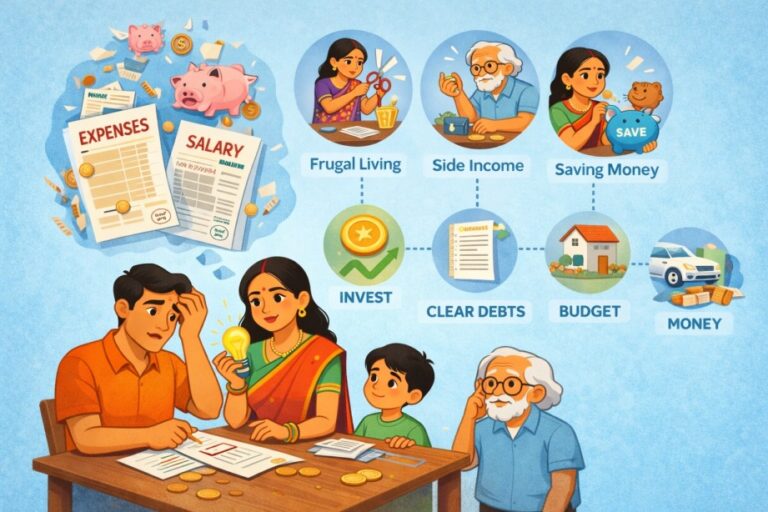

A practical Indian guide to emergency funds with real examples. Learn how much emergency fund Indian families really need, where to keep it safe, mistakes to avoid, myths vs reality, and a step-by-step roadmap.
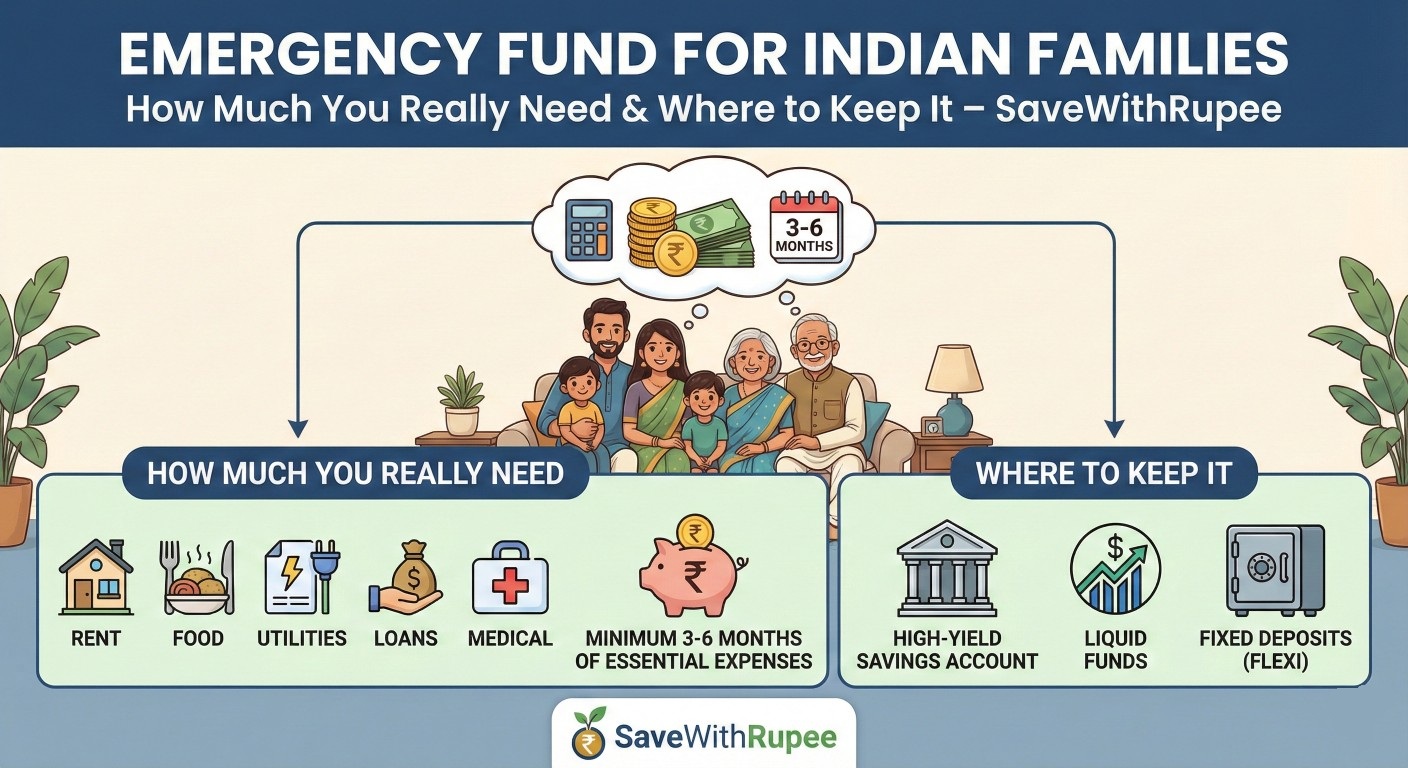
Emergency Fund for Indian Families
How Much You Really Need and Where to Keep It (Real Indian Examples)
Most Indian families don’t realise the importance of an emergency fund until life forces them to learn it the hard way.
A hospital bill.
A sudden job loss.
A family emergency back home.
And suddenly, all planning collapses.
I learned this lesson not from books, but from fear, panic, and regret.
This article is not about ideal finance theory.
It’s about real Indian households, real salaries, real responsibilities — and how an emergency fund can protect your dignity, peace, and family stability.
What Is an Emergency Fund (In Simple Indian Terms)?
An emergency fund is money kept aside only for emergencies, not for:
- Festivals
- Shopping
- Travel
- Investments
It exists for situations like:
- Medical emergencies
- Job loss or salary delay
- Sudden house repairs
- Family crisis
Think of it as financial oxygen.
You may not use it daily, but without it — survival becomes difficult.
The Day I Realised an Emergency Fund Is Non-Negotiable
Years ago, I faced a sudden medical expense in my family.
No warning.
No time to plan.
What did I do?
- Used credit card
- Borrowed from relatives
- Lost peace for months
That moment later connected deeply with
how money stress affected my life until I changed one habit.
Why Emergency Funds Are Even More Important in India
India is unique.
We deal with:
- Limited insurance coverage
- Salary delays
- Joint family responsibilities
- Medical costs that rise silently
That’s why emergency planning matters more here than in many countries.
Ignoring this is one of the biggest mistakes explained in
financial advice I wish I followed 10 years earlier.
How Much Emergency Fund Do Indian Families Really Need?
Forget generic advice.
Let’s break it down Indian-style.
The Simple Rule (That Actually Works)
👉 Minimum: 6 months of essential expenses
👉 Ideal: 9–12 months for unstable income
Not salary.
Not lifestyle expenses.
Only essential monthly costs.
Real Example With Numbers (Middle-Class Family)
Monthly Essential Expenses
| Expense | Amount (₹) |
|---|---|
| House Rent / EMI | 12,000 |
| Groceries | 6,000 |
| Electricity + Water | 2,000 |
| Transport | 3,000 |
| School Fees | 4,000 |
| Mobile + Internet | 1,000 |
| Medical / Misc | 2,000 |
| Total | 30,000 |
Emergency Fund Calculation
| Duration | Amount Needed |
|---|---|
| 6 months | ₹1,80,000 |
| 9 months | ₹2,70,000 |
| 12 months | ₹3,60,000 |
This exact calculation approach is also discussed in
how much emergency fund an Indian household really needs.
Real-Life Story #1: IT Employee With No Backup
Salary: ₹60,000
Emergency fund: ₹0
Lost job during layoffs.
Result:
- Used credit cards
- Broke investments
- Stress affected health
Lesson learned too late.
Real-Life Story #2: Auto Driver With Small Emergency Fund
Monthly income: ₹25,000
Emergency fund: ₹80,000
Faced accident repair + hospital bill.
Result:
- No borrowing
- Continued work
- Mental peace
Emergency funds don’t depend on income size — only discipline.
Myth vs Reality (Emergency Fund Edition)
| Myth | Reality |
|---|---|
| I have insurance | Insurance doesn’t cover everything |
| My job is secure | No job is permanent |
| I’ll manage somehow | “Somehow” usually means debt |
| Emergency funds reduce growth | They protect long-term wealth |
Step-by-Step Roadmap to Build an Emergency Fund
Step 1: Calculate Monthly Essentials
Exclude luxury expenses.
Step 2: Fix a Monthly Contribution
Even ₹1,000–₹3,000 is fine.
Step 3: Automate Savings
Treat it like a bill.
Step 4: Keep It Separate
Never mix with daily spending.
This saving-first habit aligns perfectly with
the only money system an Indian family needs.
Where Should Indian Families Keep Their Emergency Fund?
This is crucial.
Best Places (Ranked)
| Option | Safety | Liquidity | Returns |
|---|---|---|---|
| Savings Account | High | Very High | Low |
| Liquid Mutual Fund | High | High | Moderate |
| Sweep FD | High | Medium | Moderate |
| Cash at Home | Low | High | Zero |
Editor’s Pick ✔
👉 Savings account + Liquid fund combination
Never keep emergency funds in:
❌ Equity mutual funds
❌ Stocks
❌ Crypto
❌ Locked FDs
Real-Life Story #3: Freelancer With Variable Income
She followed advice from
how to manage money when your income changes every month.
Built 9 months emergency fund.
Result:
- No panic in low-income months
- Confidence to say “no” to bad work
Common Emergency Fund Mistakes Indians Make
- Mixing it with savings
- Using it for festivals
- Investing it for higher returns
- Not replenishing after use
- Depending fully on credit cards
Many of these mistakes also hurt people later while investing, as explained in
mistakes to avoid while starting SIP.
Do vs Avoid Table
| Do | Avoid |
|---|---|
| Keep fund liquid | Locking money |
| Use only for emergencies | Lifestyle spending |
| Refill after use | Ignoring depletion |
| Separate account | One-account chaos |
Real-Life Story #4: Family With ₹30,000 Income
They followed budgeting basics from
monthly budget plan for family with ₹30,000 income in India.
Built ₹1.5 lakh emergency fund in 18 months.
Emergency Fund Checklist (Save This)
✔ Monthly essentials calculated
✔ Target months decided
✔ Separate account created
✔ Automated transfer set
✔ Usage rules defined
✔ Refill plan ready
Pros & Cons of Emergency Fund
Pros
- Mental peace
- No debt dependency
- Financial confidence
- Family security
Cons
- Low returns
- Needs discipline
Peace is worth more than returns.
Real-Life Story #5: My Own Transformation
After building my emergency fund:
- I stopped fearing month-end
- I invested calmly
- I slept better
This change directly led to better habits described in
how I track every rupee I spend.
FAQs (Answered Honestly)
1. Is 3 months emergency fund enough?
Only for very stable jobs.
2. Should students build emergency funds?
Yes, even ₹10,000 helps.
3. Can emergency fund be invested?
No. Liquidity > returns.
4. What if I use it?
Refill immediately.
5. Is FD good for emergency fund?
Only sweep or breakable FD.
6. Should couples have joint emergency fund?
Yes, with transparency.
7. Emergency fund or SIP first?
Emergency fund always first.
Editor’s Pick (Most Important Advice)
👉 Emergency fund is not an investment. It’s protection.
Build it first.
Everything else comes later.
Strong Call To Action
If one unexpected expense can shake your family’s peace, it’s time to prepare before the crisis arrives:
Emergency Fund: How Much an Indian Household Really Needs ↗
Bookmark SaveWithRupee.com
where Indian money advice is practical, emotional, and real — built for real emergencies, real families, and real life.
Author Insight
In my own experience managing monthly expenses in India, I realized that the biggest financial problems were not due to low income, but due to lack of planning. For example, when my monthly income was around ₹25,000, I often ended up spending almost everything without saving anything at the end of the month.”
“I started tracking my expenses daily using a simple notebook. Within one month, I noticed that small, unnecessary expenses like frequent online orders and unplanned spending were taking a large portion of my income.”
“By making small changes—like setting a fixed budget for groceries, limiting online purchases, and saving at least ₹2,000 at the beginning of each month—I was able to reduce financial stress and slowly build better control over my money.” “These are simple and practical methods that any Indian household can follow without needing complex financial knowledge.”
Research Sources
- Reserve Bank of India – Financial Reports
- SEBI Investor Education
- Economic Times – Personal Finance
- Investopedia – Budgeting & Finance Basics
Disclaimer: This article is based on personal experience and is for educational purposes only. It does not constitute financial, investment, or legal advice. Readers are advised to do their own research or consult a qualified professional before making any financial decisions.