
A complete, practical, rural-friendly guide explaining the Housing for All Scheme India 2025 (PMAY–Gramin). Learn eligibility, subsidy benefits, documents, step-by-step process, and real-life success stories from Indian villages.
🔥 Strong Intro (No Questions)
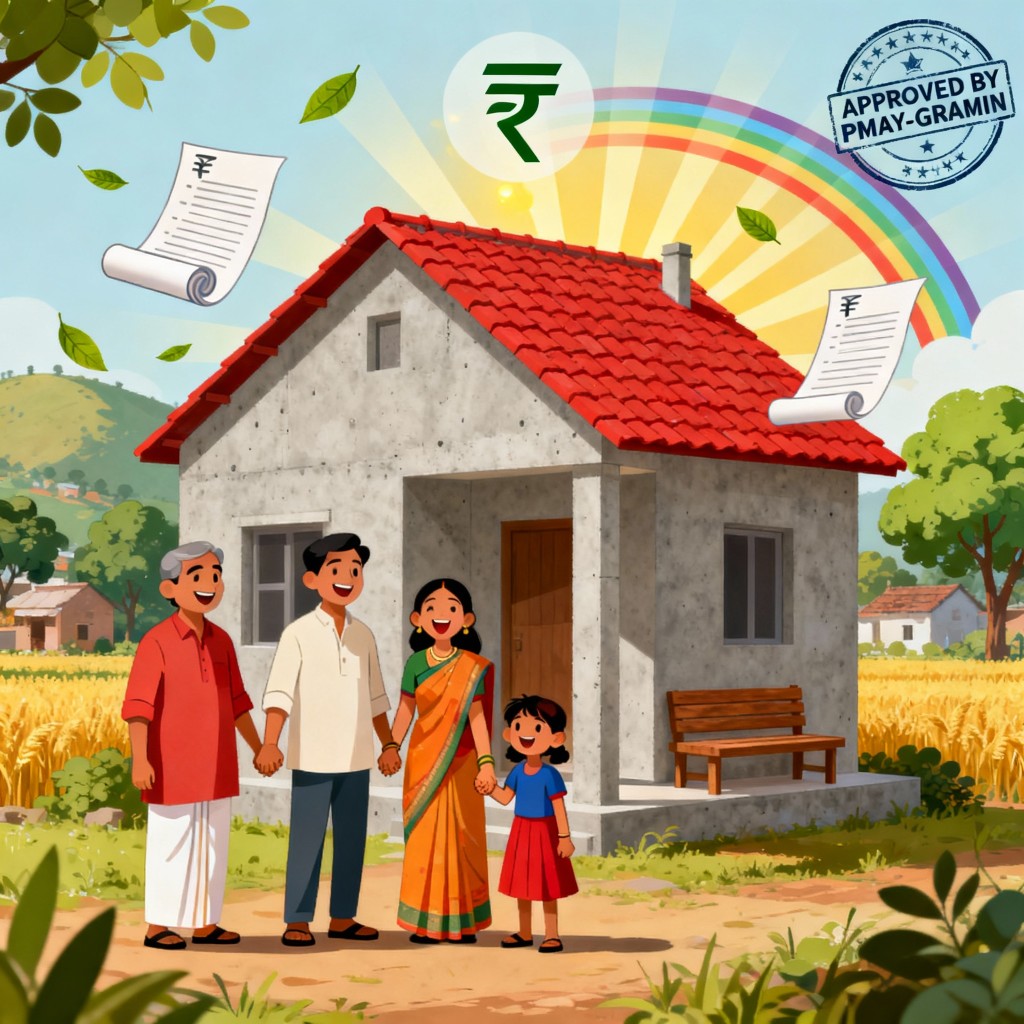
A permanent home is more than four walls—it is dignity, safety, and emotional security for every Indian family. For crores of rural households, “Housing for All” has been a long-awaited dream. Through the PMAY–Gramin (Pradhan Mantri Awas Yojana – Rural) and other 2025 rural housing initiatives, the Government of India continues to support low-income families in building homes with strong subsidies and financial assistance.
This guide simplifies everything—eligibility, documents, benefits, timelines, real stories, and application steps—in a clear, practical, Indian way.
⭐ Key Takeaways
- PMAY-G offers ₹1.20 lakh to ₹1.30 lakh assistance for rural pucca houses.
- Priority is given to low-income families, labour workers, SC/ST, and kutcha-house residents.
- Beneficiaries are selected using SECC (Socio-Economic Caste Census) lists.
- Money is transferred directly to the applicant’s bank account.
- Toilet construction assistance under Swachh Bharat Mission may also be provided.
- Process is fully digital through the official PMAY-G portal.
📚 Table of Contents (Numbered)
- 🏡 Understanding Housing for All (Rural) – PMAY-G
- 💰 Financial Assistance & Subsidy Details (2025)
- 🧾 Eligibility Criteria
- 📄 Required Documents
- 🧮 Step-by-Step Application Process
- 🛠 How Houses Are Constructed Under PMAY-G
- 🌾 Real Rural Success Stories
- 🔍 Comparison Table – Rural vs Urban Housing Schemes
- 👍 Pros & Cons of PMAY-G
- ⚠ Common Mistakes Applicants Make
- 🛠 Tools & Free Government Resources
- 🔗 Internal & External Useful Links
- 👪 Who Should Apply
- 📌 Quick Application Checklist
- ❓ FAQs
- 🧩 Final Summary
🏡 1. Understanding Housing for All (Rural) – PMAY-G
Pradhan Mantri Awas Yojana – Gramin (PMAY-G) aims to provide pucca houses to all rural households living in:
- Kutcha houses
- Houses with weak structures
- Houses without separate rooms
- Family size exceeding available space
- Below-poverty-line and vulnerable groups
Core features:
- Strong structure
- Sanction amount directly to bank account
- Geo-tagged monitoring
- Construction-based installments
- Support for toilets, LPG connection, and water supply
Official link (trusted):
https://pmayg.nic.in/
💰 2. Financial Assistance & Subsidy Details (2025)
For 2025, rural households receive:
- ₹1,20,000 for plain areas
- ₹1,30,000 for hilly/difficult areas
- Additional ₹12,000 for toilet construction (Swachh Bharat Mission)
- MGNREGA wage support for construction labour
- Bank loans up to ₹70,000 (optional)
These values may differ slightly based on the state.
🧾 3. Eligibility Criteria
You may qualify if:
- You live in a kutcha house
- You have no permanent (pucca) home
- Your household income is low
- You belong to SC/ST, minority, or economically weaker sections
- You don’t own a strong concrete house
- Your name appears in the SECC 2011 list
- You don’t pay income tax
- You don’t own a 4-wheeler
- No one in the house is a government employee
Priority is given to:
- Labour workers
- Widows
- Physically disabled individuals
- Landless labour families
📄 4. Required Documents
- Aadhaar card
- Voter ID card
- MGNREGA job card (if applicable)
- Bank passbook
- Rural land ownership proof
- Ration card
- Mobile number
- Photograph
- Consent for Aadhaar authentication
🧮 5. Step-by-Step Application Process
Step 1: Check Your Name in PMAY-G List
Visit: https://pmayg.nic.in/netiay/home.aspx
Search by Aadhaar or registration number.
Step 2: Visit Gram Panchayat Office
Confirm your eligibility with local officers.
Step 3: Document Verification
Provide Aadhaar, land documents, bank details.
Step 4: Geo-Tagging of Your Land
Government approved person will take photos on-site.
Step 5: Sanction & Approval
Your home is sanctioned in installments.
Step 6: Construction Begins
You build the house or hire labour.
Step 7: Installment Release
Funds are released after each construction stage.
Step 8: Final Inspection + Completion
House must meet pucca standards.
🛠 6. How Houses Are Constructed Under PMAY-G
Construction is done in phases:
- Foundation
- Plinth
- Walls
- Roof
- Finishing (doors, windows, flooring)
Beneficiary receives money in stages:
- 1st installment → start work
- 2nd installment → after plinth
- Final installment → after roof completion
MGNREGA wages support labour work, reducing overall cost.
🌾 7. Real Rural Success Stories
⭐ Story 1: Jharkhand Widow Receives New Home
Sunita Devi, living in a broken mud house, received PMAY-G assistance in 2024. With the first installment, she built a strong foundation. Today, she proudly lives in a pucca home with electricity and water.
⭐ Story 2: Odisha Daily-Wage Worker
Ramesh, a landless labourer, used PMAY-G support + MGNREGA wages. He completed his home within 11 months and now has a safe house for his children during cyclone seasons.
⭐ Story 3: Tamil Nadu Rural Farmer
Muthukumar built a two-room home under PMAY-G. The toilet support from Swachh Bharat Mission made his family’s life healthier and more dignified.
🔍 8. Comparison Table – Rural vs Urban Housing Schemes
| Feature | PMAY-G (Rural) | PMAY-U (Urban) |
|---|---|---|
| Financial help | ₹1.20–₹1.30 lakh | Credit-linked subsidy |
| Beneficiaries | Rural poor | Urban poor/middle class |
| Approval based on | SECC list | Income categories |
| Toilet construction | Yes | No |
| Geo-tagging | Yes | Yes |
| Installment method | Construction-based | Loan-based |
👍 9. Pros & Cons of PMAY-G
Pros
- Direct benefit to rural poor
- Simple documentation
- Support from multiple schemes (SBM, MGNREGA)
- No middlemen needed
- Transparent process via geo-tagging
Cons
- Requires land ownership
- Construction may be slow
- Some local approvals take time
- Beneficiary must supervise construction
⚠ 10. Common Mistakes Applicants Make
- Not checking their name on the official list
- Relying on agents or middlemen
- Providing incorrect land details
- Delay in starting construction after receiving funds
- Not maintaining bank SMS/updates
🛠 11. Tools & Free Government Resources
- PMAY-G Portal: https://pmayg.nic.in/
- SECC Data Check: https://pmayg.nic.in/netiay/home.aspx
- State Rural Housing Portals
- MGNREGA Support: https://nrega.nic.in/
- Swachh Bharat Mission Support: https://swachhbharatmission.gov.in/
🔗 12. Internal & External Useful Links
Internal SaveWithRupee Guides
- How to Build Wealth Slowly in India
- Emergency Fund Guide for Indian Families
- Best Side Income Ideas in India
External Trusted References
- PMAY-G Portal: https://pmayg.nic.in
- India Government Portal: https://www.india.gov.in
- Rural Development Ministry: https://rural.nic.in
👪 13. Who Should Apply
This scheme is perfect for:
- Rural households in kutcha homes
- Families with unstable house structures
- SC/ST households
- Landless labourers (if allotted land)
- Low-income villagers
- Widows, disabled individuals, elderly
📌 14. Quick Application Checklist
- Check your name in PMAY-G list
- Prepare Aadhaar + bank details
- Visit Gram Panchayat
- Get land verified
- Complete geo-tagging
- Start construction
- Receive installments in phases
- Complete the house as per norms
❓ 15. FAQs
Q1. Can I apply online myself?
You can check eligibility online but must apply through village bodies.
Q2. How long does approval take?
30–90 days depending on verification.
Q3. Do I need to pay any fee?
No. PMAY-G is 100% free—avoid agents.
Q4. Can I build a bigger house than the sanctioned amount?
Yes—but extra cost must be from your pocket.
Q5. Can I apply without land?
You need land or land allotment from authorities.
🧩 Final Summary
The Housing for All Scheme (PMAY-G) is one of India’s strongest rural development initiatives—bringing dignity and security to families who have lived in unsafe structures for generations. With subsidies, toilet support, direct bank transfers, and transparent monitoring, the dream of a pucca home is now achievable for millions.
If you are a rural family with limited income, this guide gives you everything you need to apply confidently and successfully.
Author Insight
In my own experience managing monthly expenses in India, I realized that the biggest financial problems were not due to low income, but due to lack of planning. For example, when my monthly income was around ₹25,000, I often ended up spending almost everything without saving anything at the end of the month.”
“I started tracking my expenses daily using a simple notebook. Within one month, I noticed that small, unnecessary expenses like frequent online orders and unplanned spending were taking a large portion of my income.”
“By making small changes—like setting a fixed budget for groceries, limiting online purchases, and saving at least ₹2,000 at the beginning of each month—I was able to reduce financial stress and slowly build better control over my money.” “These are simple and practical methods that any Indian household can follow without needing complex financial knowledge.”
Research Sources
- Reserve Bank of India – Financial Reports
- SEBI Investor Education
- Economic Times – Personal Finance
- Investopedia – Budgeting & Finance Basics
Disclaimer: This article is based on personal experience and is for educational purposes only. It does not constitute financial, investment, or legal advice. Readers are advised to do their own research or consult a qualified professional before making any financial decisions.