

Introduction
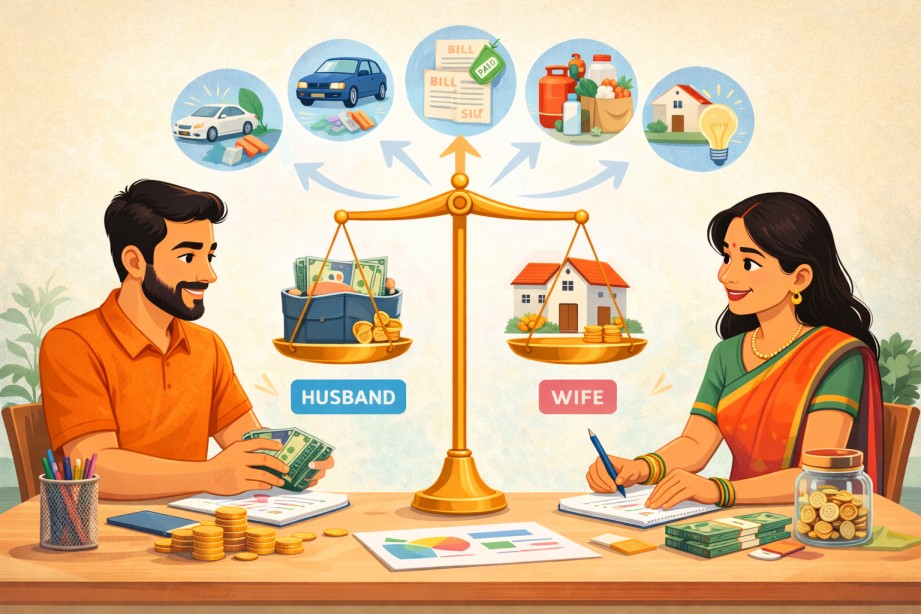
In today’s India, managing money as a couple is no longer as simple as it used to be. With rising living costs, dual-income households, and increasing financial responsibilities, many couples struggle with one important question:
“How do we divide household expenses fairly?”
This is not just a financial issue—it is an emotional one.
In many homes, arguments don’t happen because of lack of money, but because of:
- unclear expectations
- unequal burden
- poor communication
The truth is simple:
👉 Fair does not always mean equal.
👉 And every couple needs a system that works for them—not society.
In this detailed guide, you will learn:
- Practical ways Indian couples divide expenses
- Real-life examples with salary numbers
- Mistakes most couples make (and how to avoid them)
- A step-by-step system you can follow immediately
Why Dividing Expenses Properly Matters
Money problems are one of the most common reasons for stress in relationships.
When couples don’t have a clear system:
- One partner may feel overburdened
- The other may feel controlled or judged
- Small expenses can turn into big arguments
But when finances are handled properly:
✔ You reduce unnecessary fights
✔ You build trust and transparency
✔ You plan future goals better
✔ You feel like a team—not competitors
If you want a complete system to manage family money, you can also read this:
👉 https://savewithrupee.com/the-only-money-system-an-indian-family-needs-simple-sustainable-stress-free/
Real-Life Situation: Why “Equal Split” Often Fails
Let’s take a simple example:
- Husband earns ₹80,000
- Wife earns ₹30,000
- Monthly expenses: ₹40,000
If both pay ₹20,000 each:
👉 Husband still has ₹60,000 left
👉 Wife has only ₹10,000 left
Is this equal? Yes.
Is this fair? No.
This is where many couples start feeling financial pressure silently.
4 Common Ways Couples Divide Household Expenses
Let’s look at practical methods used in Indian households.
1. Equal Split Method (50–50)
Both partners contribute the same amount.
Best for:
- Couples earning similar salaries
Problem:
- Creates imbalance when incomes differ
👉 Works only in limited situations.
2. Income Percentage Method (Most Practical)
Each partner contributes based on income ratio.
Example:
- Husband: ₹60,000 → 60%
- Wife: ₹40,000 → 40%
Total expenses: ₹30,000
- Husband pays ₹18,000
- Wife pays ₹12,000
👉 This is the most balanced system.
3. Category-Based Method
Each partner takes responsibility for specific expenses.
Example:
- Rent → Husband
- Groceries → Wife
- Utilities → Shared
Best for:
- Couples who like managing specific areas
4. One Income for Expenses, One for Savings
- One salary → daily expenses
- Other salary → savings/investments
👉 Works well if income is stable.
Step-by-Step System to Divide Expenses Fairly
This is the most important part. Follow this exactly.
Step 1: Share Income Honestly
Both partners must clearly disclose income.
Example:
- Partner A: ₹50,000
- Partner B: ₹35,000
Total: ₹85,000
👉 No hiding. No guessing.
Step 2: List All Monthly Expenses
Include everything:
- Rent / EMI
- Groceries
- Electricity
- Internet
- Transport
- Miscellaneous
If you struggle with planning expenses, read:
👉 https://savewithrupee.com/how-indian-families-can-plan-monthly-expenses-without-arguments/
Step 3: Choose the Right Method
👉 If incomes differ → use percentage method
👉 If similar → equal split is okay
Step 4: Create a Joint Expense System
You don’t need a joint account, but it helps.
Simple system:
- Both transfer money monthly
- Pay all expenses from one place
👉 Reduces confusion.
Step 5: Keep Personal Money Separate
This is very important.
Each partner should have:
- Personal spending money
- No questions asked
👉 This avoids unnecessary arguments.
Step 6: Plan Savings Together
Expenses should not consume all income.
Important goals:
- Emergency fund
- Future investments
- Children’s education
Start here:
👉 https://savewithrupee.com/emergency-fund-for-indian-families-how-much-you-really-need-where-to-keep-it-savewithrupee/
Real Indian Example (Detailed Case Study)
Let’s take a realistic middle-class scenario:
- Husband salary: ₹70,000
- Wife salary: ₹50,000
- Total income: ₹1,20,000
Monthly expenses: ₹60,000
Step 1: Calculate Percentage
- Husband → 58%
- Wife → 42%
Step 2: Contribution
- Husband pays ₹34,800
- Wife pays ₹25,200
Step 3: Remaining Money
- Husband: ₹35,200 left
- Wife: ₹24,800 left
👉 Both have fair financial freedom.
Common Mistakes Couples Must Avoid
❌ 1. Not Talking About Money
Silence creates assumptions.
👉 Always discuss openly.
❌ 2. One Person Paying Everything
This creates long-term imbalance and stress.
❌ 3. Ignoring Small Expenses
Small leaks destroy budgets.
Learn more:
👉 https://savewithrupee.com/hidden-monthly-expenses-middle-class-indians-ignore-until-year-end/
❌ 4. No Expense Tracking
If you don’t track, you lose control.
❌ 5. No Financial Goals
Without goals, money disappears.
Practical Tips to Manage Money as a Couple
✔ Have a Monthly Money Meeting
Just 20–30 minutes is enough.
✔ Decide Big Purchases Together
- TV
- Mobile
- Travel
👉 Avoid surprise spending.
✔ Track Every Rupee
You can even use a simple notebook.
✔ Build Extra Income
Side income reduces pressure.
Explore:
👉 https://savewithrupee.com/passive-income-ideas-in-india-2025-12-real-ways-to-earn-while-you-sleep/
Emotional Side of Money (Most Ignored)
Money is not just numbers.
It includes:
- Ego
- Fear
- Security
- Lifestyle expectations
Sometimes:
- One partner wants to save
- Other wants to enjoy
👉 Both are valid.
The solution is not control—it is balance.
Which Method Is Best?
| Method | Fairness | Best For |
|---|---|---|
| Equal Split | Medium | Same income |
| Percentage | High | Different income |
| Category-Based | Medium | Flexible couples |
| One Income System | Medium | Strong savings focus |
👉 Best overall: Income Percentage Method
Frequently Asked Questions
1. Should couples split expenses equally?
Not always. Percentage-based is more fair when incomes differ.
2. Is a joint account necessary?
No, but it makes management easier.
3. What if one partner earns more?
They can contribute more while keeping fairness.
4. Should personal spending be allowed?
Yes. It is essential for peace.
5. How often should finances be discussed?
At least once a month.
Final Thoughts
Dividing household expenses is not about strict rules.
It is about:
- fairness
- communication
- mutual respect
The strongest couples are not those who earn the most.
👉 They are the ones who manage money together without conflict.
If you create a simple, clear system:
- money stress reduces
- savings increase
- relationship becomes stronger
Personal Insight (Real Experience)
When I started managing money seriously, I made one big mistake:
👉 I assumed “equal sharing” is always fair.
But reality was different.
There were months when:
- expenses increased
- income differences mattered
- stress slowly built up
The turning point came when I:
- started tracking expenses
- switched to percentage-based sharing
- discussed money openly
Within a few months:
- financial stress reduced
- savings improved
- arguments disappeared
👉 The system matters more than income.
Author Insight
In my own experience managing monthly expenses in India, I realized that the biggest financial problems were not due to low income, but due to lack of planning. For example, when my monthly income was around ₹25,000, I often ended up spending almost everything without saving anything at the end of the month.”
“I started tracking my expenses daily using a simple notebook. Within one month, I noticed that small, unnecessary expenses like frequent online orders and unplanned spending were taking a large portion of my income.”
“By making small changes—like setting a fixed budget for groceries, limiting online purchases, and saving at least ₹2,000 at the beginning of each month—I was able to reduce financial stress and slowly build better control over my money.” “These are simple and practical methods that any Indian household can follow without needing complex financial knowledge.”
Research Sources
- Reserve Bank of India – Financial Reports
- SEBI Investor Education
- Economic Times – Personal Finance
- Investopedia – Budgeting & Finance Basics
Disclaimer: This article is based on personal experience and is for educational purposes only. It does not constitute financial, investment, or legal advice. Readers are advised to do their own research or consult a qualified professional before making any financial decisions.