

Confused between mutual funds and fixed deposits? Here’s a detailed 2026 guide comparing risk, returns, tax, and liquidity — with real stories, tables, and smart tips to choose what’s right for you.
last updated : 22-02-2026
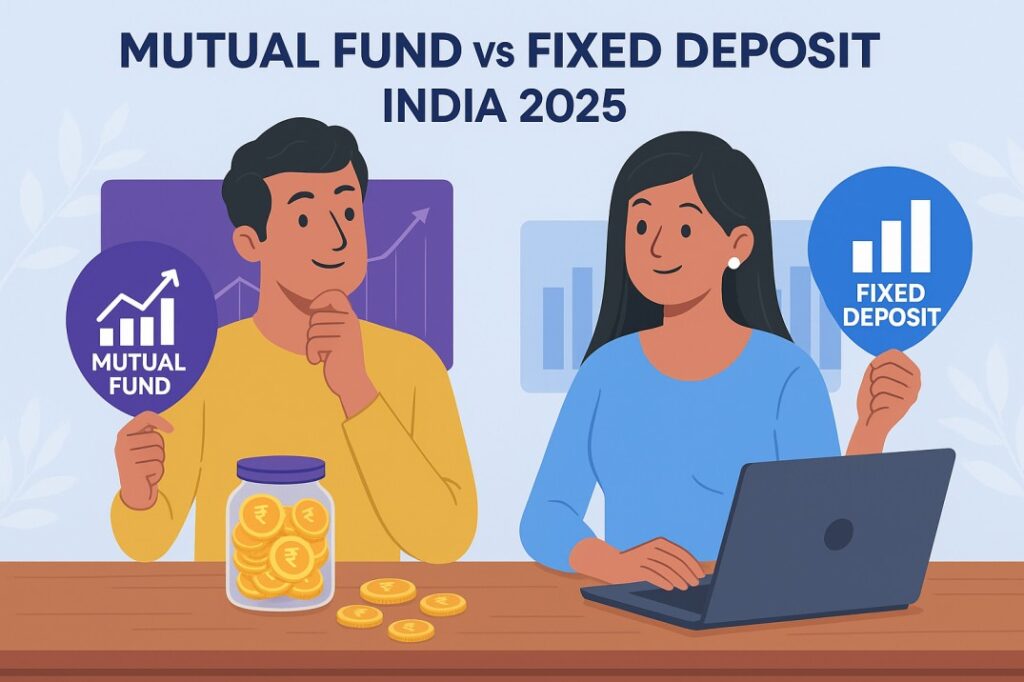
Mutual Fund vs Fixed Deposit – Which is Better in India 2026?
Complete Beginner’s Guide
If you ask any middle-class Indian where to invest money, two answers usually come up:
- “FD kar do.”
- “Mutual fund better hai.”
Both are popular.
Both are trusted.
But they work very differently.
In 2026, with changing interest rates and market conditions, choosing between Mutual Funds and Fixed Deposits (FDs) depends not on trends—but on your goals, risk appetite, and time horizon.
Let’s break it down clearly, without technical confusion.
What Is a Fixed Deposit (FD)?
A Fixed Deposit is simple.
You:
- Deposit money in a bank
- Lock it for a fixed period
- Earn fixed interest
Example:
- ₹1,00,000 for 1 year
- Interest rate: 6.5%–7.5% (varies by bank in 2026)
- Guaranteed return
FD is predictable and stable.
That’s why many Indian families feel comfortable with it.
If you want a deeper understanding of how FDs compare with similar products, this article on FD vs RD – which is better for Indians explains fixed-income basics clearly.
What Is a Mutual Fund?
A Mutual Fund pools money from many investors and invests it in:
- Stocks
- Bonds
- Government securities
- Or a mix of these
Returns are not fixed.
They depend on market performance.
But over long periods, mutual funds—especially equity funds—have historically beaten inflation.
For beginners, SIP is the most popular way to invest in mutual funds, as explained in SIP for beginners – start with ₹500.
Key Differences: Mutual Fund vs Fixed Deposit (2026 Comparison)
1. Safety
FD:
- Very low risk
- Bank-backed
- Guaranteed return
Mutual Fund:
- Market-linked
- Value may fluctuate
- Long-term risk reduces with time
If safety is your top priority, FD wins.
2. Returns (Long-Term)
FD:
- Typically 6%–7.5% in 2026
- Fixed and predictable
Mutual Fund (Equity-oriented):
- Historically higher over 10+ years
- Not guaranteed
- Market-dependent
For beating inflation long-term, mutual funds usually perform better.
3. Liquidity
FD:
- Premature withdrawal allowed (with penalty)
Mutual Fund:
- Can be redeemed anytime (except lock-in funds like ELSS)
- No penalty in most open-ended funds
Both are reasonably liquid, but mutual funds often provide easier access.
4. Taxation
FD:
- Interest fully taxable as per your income slab
Mutual Fund:
- Tax depends on holding period and type
- Long-term capital gains tax rules apply
For higher tax bracket individuals, mutual funds may offer better tax efficiency.
5. Inflation Impact
Inflation in India averages around 6–7%.
If your FD earns 6.5% and inflation is 6%:
- Real return is minimal
Equity mutual funds have potential to grow beyond inflation over time.
That’s why long-term wealth builders often prefer mutual funds, as explained in how to build wealth slowly in India.
When Fixed Deposit Is Better
FD is better if:
- You need money within 1–3 years
- You cannot tolerate any risk
- You want predictable income
- You are building emergency fund
Emergency funds should ideally stay in safe options, as explained in emergency fund planning for Indian households.
Stability matters more than high return here.
When Mutual Fund Is Better
Mutual fund is better if:
- Your goal is 5+ years away
- You want wealth growth
- You can tolerate short-term ups and downs
- You want to beat inflation
Disciplined investing works best for long-term goals.
Real-Life Example (Simple & Practical)
Let’s compare ₹1,00,000 invested for 10 years.
FD at 7%:
- Grows steadily
- Predictable
Equity mutual fund (average long-term performance example):
- May fluctuate
- But potentially higher growth
However:
- Market volatility can create temporary dips
- Emotional discipline is required
Choosing depends on your comfort level.
Can You Use Both?
Yes—and that’s often the smartest strategy.
Example approach:
- Emergency fund → FD
- Short-term goals → FD or debt mutual fund
- Long-term goals → Equity mutual fund
Diversification reduces stress and balances growth with safety.
This balanced thinking is common among disciplined middle-class investors, as explained in smart investment habits of middle-class Indians.
Common Mistakes Beginners Make
- Putting all money in equity without emergency fund
- Keeping all savings in FD for 15 years
- Chasing high returns blindly
- Ignoring inflation
- Switching frequently
No investment is “best” for everyone.
Suitability matters more than popularity.
Quick Summary (Simple Decision Guide)
Choose FD if:
- You want safety
- You need money soon
- You dislike volatility
Choose Mutual Fund if:
- You invest long-term
- You want growth
- You can stay disciplined
Use both if:
- You want balance
FAQs
1. Is mutual fund risky in 2026?
Yes, market risk exists. But long-term disciplined investing reduces volatility impact.
2. Is FD completely safe?
Bank FDs are generally low-risk, but returns may not beat inflation.
3. Can beginners start with mutual funds?
Yes, starting with SIP makes it easier and structured.
4. Which gives higher return?
Mutual funds may give higher long-term returns, but they are not guaranteed.
5. Should I move all money from FD to mutual fund?
No. Keep emergency funds safe and invest extra for growth.
Final Thoughts
In 2026, the question is not:
“Which is better?”
The real question is:
“What is better for your goal?”
FD gives peace.
Mutual funds give growth.
The smartest Indian investors don’t pick sides.
They build balance.
Understand your needs.
Choose wisely.
Stay consistent.
Author Insight
In my own experience managing monthly expenses in India, I realized that the biggest financial problems were not due to low income, but due to lack of planning. For example, when my monthly income was around ₹25,000, I often ended up spending almost everything without saving anything at the end of the month.”
“I started tracking my expenses daily using a simple notebook. Within one month, I noticed that small, unnecessary expenses like frequent online orders and unplanned spending were taking a large portion of my income.”
“By making small changes—like setting a fixed budget for groceries, limiting online purchases, and saving at least ₹2,000 at the beginning of each month—I was able to reduce financial stress and slowly build better control over my money.” “These are simple and practical methods that any Indian household can follow without needing complex financial knowledge.”
Research Sources
- Reserve Bank of India – Financial Reports
- SEBI Investor Education
- Economic Times – Personal Finance
- Investopedia – Budgeting & Finance Basics
Disclaimer: This article is based on personal experience and is for educational purposes only. It does not constitute financial, investment, or legal advice. Readers are advised to do their own research or consult a qualified professional before making any financial decisions.