
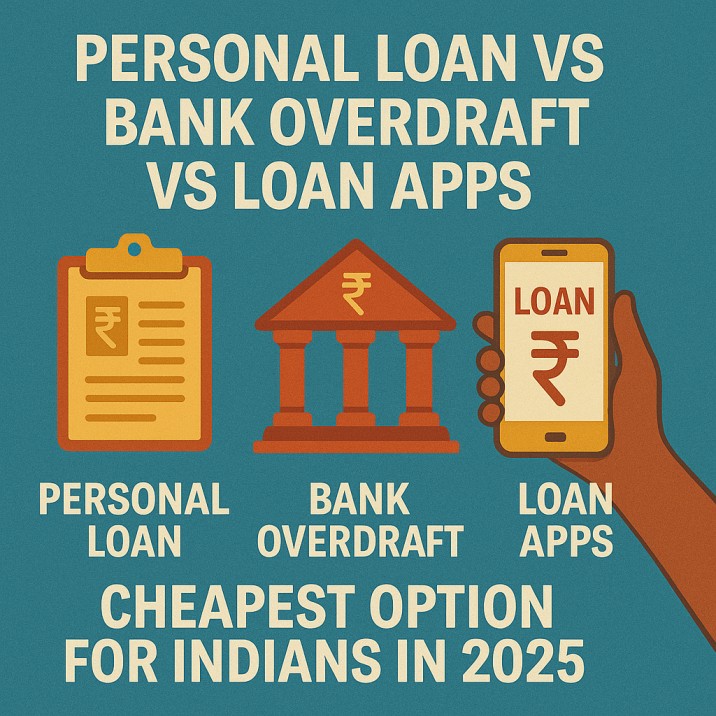
Confused between personal loans, bank overdrafts, and loan apps? This 2025 Indian guide compares interest rates, charges, risks, real stories, pros & cons, and the cheapest option for your needs.
📌 Key Takeaways
- A personal loan is best for big planned expenses (lower interest, fixed EMI).
- A bank overdraft is ideal for short-term cash gaps (you pay interest only on what you use).
- Loan apps are fast but risky—higher interest, hidden charges, and penalties.
- For most Indians in 2025, a small personal loan or overdraft is cheaper than borrowing from loan apps.
- Before borrowing any money, build a safety net. Start here:
👉 Emergency Fund Guide 2025
📚 Table of Contents
- 🔍 Understanding the 3 Loan Types
- Why Indians Take Quick Loans in 2025
- 🥇 Which Loan Is Cheaper? (Quick Summary Table)
- 🔎 Personal Loan – Full Breakdown
- 🏦 Bank Overdraft – Full Breakdown
- 📱 Loan Apps – Full Breakdown
- ⚖ Side-by-Side Comparison (The Ultimate Table)
- 🧠 Which One Should YOU Choose? (Use-Case Based)
- 📉 Common Mistakes Indians Make While Borrowing
- 📱 Best Tools & Apps to Compare Loans Safely
- 🧑💼 Real Indian Stories (True Case Studies)
- 🎯 Who This Guide Is For
- 📝 Quick Action Checklist
- ❓ FAQs – Most Asked Questions
- ⭐ Editor’s Pick (Handpicked SaveWithRupee Guides)
- 🧾 Final Summary
🔍 1. Understanding the 3 Loan Types
Before choosing between personal loan, bank overdraft, or loan apps, understand how each works.
🏦 Personal Loan
A fixed amount loan from a bank/NBFC for 1–5 years with monthly EMIs.
✔ Ideal for: medical bills, education, home repairs, debt consolidation
✔ Predictable repayment
✔ Lower interest compared to loan apps
Learn more money-saving strategies here:
👉 Smart Investment Habits of Middle-Class Indians
💳 Bank Overdraft (OD Facility)
A flexible credit limit attached to your existing bank account.
✔ You pay interest only on the amount you use
✔ Perfect for short-term or seasonal cash shortages
✔ Helps avoid delays in rent/fees
This is also linked to good budgeting practices:
👉 50-30-20 Rule of Budgeting for Indians
📱 Loan Apps
Instant loans via mobile apps. Fast—but costly.
✔ Instant approval
✔ Minimal paperwork
✘ High interest & hidden fees
✘ Penalty charges
✘ Mental pressure from aggressive reminders
If loan apps stress you, consider these instead:
👉 How to Save ₹5000 Every Month Without Sacrifice
2. Why Indians Take Quick Loans in 2025
- Medical emergencies
- School/college fees
- Rent deposit
- Festival expenses
- Travel or home repairs
- To pay off existing high-interest debt
Before borrowing, ALWAYS prepare a safety net:
👉 Emergency Fund Guide 2025
🥇 3. Which Loan Is Cheaper? (Quick Summary Table)
| Loan Type | Interest Range | When It’s Best | Risk Level | Cheapest When… |
|---|---|---|---|---|
| Personal Loan | ⭐ 10–18% | Big planned needs | Low | Borrowing ₹50k–₹5 lakh |
| Bank Overdraft | ⭐ 12–20% (only on used amount) | Short-term gaps | Medium | Use small amount for few days/weeks |
| Loan Apps | ❌ 24–60% | Emergency only | High | Almost never |
👉 Verdict: Personal loan or OD is cheaper. Loan apps are last resort.
🔎 4. Personal Loan – Full Breakdown
🏷️ Features
- Tenure: 12–60 months
- EMI-based
- Lower interest
- Documents: ID + salary proof
✔ Advantages
- Lowest interest among all 3
- Predictable EMI
- Good for debt consolidation
- Improves credit score
❌ Disadvantages
- Takes 24–72 hours
- Requires income proof
- Processing fee applies
🏦 5. Bank Overdraft – Full Breakdown
🧾 Features
- Limit usually 1–3× monthly salary
- Interest charged ONLY on amount used
- No fixed EMI
✔ Advantages
- Perfect for short-term needs
- Cheaper than loan apps
- No penalty if not used
- Useful for freelancers/business owners
❌ Disadvantages
- Higher interest than personal loan
- Easy to misuse
- Bank may reduce limit if salary drops
This pairs well with weekly budgeting:
👉 Weekly vs Monthly Budget – Which Works Better?
📱 6. Loan Apps – Full Breakdown
⚡ Features
- Disbursal in 5 minutes
- No income proof required
- High default charges
✔ Advantages
- Extreme speed
- Can help in sudden emergencies
❌ Disadvantages (Major)
- Highest interest
- Hidden processing fees
- Daily interest/penalties
- Harassment-level reminders
- Damages CIBIL if unpaid
If loan apps feel risky, try earning extra income:
👉 10 Side Hustles for Indians in 2025
⚖ 7. Side-by-Side Comparison (Ultimate Table)
| Feature | Personal Loan | Bank Overdraft | Loan App |
|---|---|---|---|
| Interest | ⭐ Low | ⭐ Medium | ❌ Very High |
| Speed | Moderate | Fast | Super-Fast |
| EMI | Yes | No | Sometimes |
| Hidden Fees | Low | Low | High |
| Best For | Big planned expenses | Short-term gaps | Emergency only |
| Risk | Low | Medium | High |
🧠 8. Which One Should YOU Choose? (Use-Case Based)
🩺 For Medical Emergencies
➡ Bank Overdraft
(Use only for a few weeks → cheaper than loan app)
🎒 For School/College Fees
➡ Personal Loan
(Fixed EMI → stable planning)
🏠 For Rent Deposit
➡ Personal Loan or Overdraft
📱 For Instant Cash (last minute)
➡ Loan App ONLY if nothing else works
But before borrowing, also check these:
👉 How to Save Money on Mobile Recharge Plans
📉 9. Common Mistakes Indians Make While Borrowing
❌ Borrowing more than needed
❌ Ignoring processing fees
❌ Paying EMIs late
❌ Borrowing from loan apps frequently
❌ Not tracking total EMI burden
❌ Using loan apps for shopping or lifestyle spending
Avoid these with clean budgeting:
👉 15 Daily Money Hacks to Save ₹10,000 This Year
📱 10. Best Tools & Apps to Compare Loans Safely
- Bank EMI calculators
- Online loan comparison tools
- Savings apps
- Budgeting apps
Explore free tools here:
👉 Best Free Budgeting Apps in India 2025
🧑💼 11. Real Indian Stories (True Case Studies)
👩 Story 1: Rashmi (Bangalore)
Needed ₹25,000 for medical tests.
- Loan app offered: 32% interest
- Bank overdraft used for 21 days: Saved ₹1,900
👨🔧 Story 2: Arvind (Delhi)
Wanted ₹1 lakh for house repairs.
- Overdraft was expensive
- Personal loan EMI: much cheaper
👨🎓 Story 3: Student Kiran
Borrowed ₹9k from a loan app.
Due to late payment, total payable=₹14,800.
He now follows:
👉 How to Save ₹100 Daily Challenge
🎯 12. Who This Guide Is For
- Salaried employees
- Gig workers
- Small business owners
- Students
- Homemakers
- Anyone comparing borrowing options in 2025
📝 13. Quick Action Checklist
✔ Compare all 3 loan types
✔ Check interest + processing fee
✔ Avoid loan apps unless emergency
✔ Calculate how quickly you can repay
✔ Check credit score before applying
✔ Build an emergency fund
✔ Try earning a side income before borrowing
❓ 14. FAQs – Most Asked Questions
Q1. Which is cheapest: personal loan or overdraft?
➡ Personal loan is cheaper for large amounts.
➡ Overdraft is cheaper for small, short-term needs.
Q2. Are loan apps safe?
Use only RBI-registered apps. Avoid unknown ones.
Q3. Can I take two loans at once?
Yes, but your credit score must support repayment.
Q4. Is overdraft better than credit card?
For short-term needs, yes, because interest applies only to the amount used.
⭐ 15. Editor’s Pick – Recommended SaveWithRupee Guides
- How to Improve Your CIBIL Score Fast
- Credit Score in India – Beginner’s Guide
- Credit Card Debt in India – Smart Plan to Pay Off
- Best Low-Cost Saving Schemes in India 2025
- How to Save Money on School Tuition Fees
🧾 16. Final Summary – The Clear Winner
After comparing personal loan vs bank overdraft vs loan app, here’s the answer:
🥇 Cheapest for Most Indians:
➡ Personal Loan
🥈 Cheapest for Short-Term Use:
➡ Bank Overdraft
🥉 Most Expensive & Risky:
➡ Loan Apps
If you can avoid borrowing, do it.
If you must borrow, choose wisely.
And meanwhile, build a small savings cushion using:
👉 How to Save Money on a Small Salary (Full Guide)
Author Insight
In my own experience managing monthly expenses in India, I realized that the biggest financial problems were not due to low income, but due to lack of planning. For example, when my monthly income was around ₹25,000, I often ended up spending almost everything without saving anything at the end of the month.”
“I started tracking my expenses daily using a simple notebook. Within one month, I noticed that small, unnecessary expenses like frequent online orders and unplanned spending were taking a large portion of my income.”
“By making small changes—like setting a fixed budget for groceries, limiting online purchases, and saving at least ₹2,000 at the beginning of each month—I was able to reduce financial stress and slowly build better control over my money.” “These are simple and practical methods that any Indian household can follow without needing complex financial knowledge.”
Research Sources
- Reserve Bank of India – Financial Reports
- SEBI Investor Education
- Economic Times – Personal Finance
- Investopedia – Budgeting & Finance Basics
Disclaimer: This article is based on personal experience and is for educational purposes only. It does not constitute financial, investment, or legal advice. Readers are advised to do their own research or consult a qualified professional before making any financial decisions.