
Scared of investing? Learn the safest, fear-free way Indians can start investing step by step. Real stories, myths vs reality, mistakes, tables, checklist, and a simple roadmap.
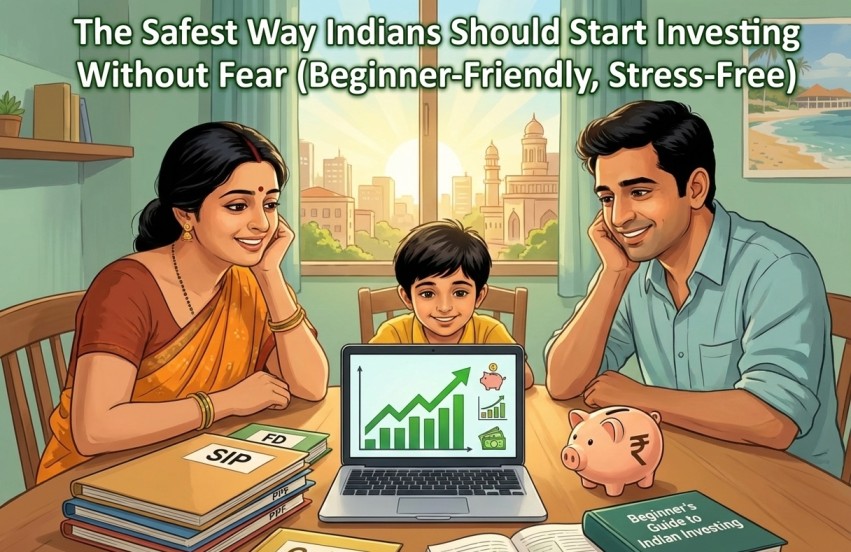
The Safest Way Indians Should Start Investing Without Fear
(A calm, practical guide for beginners who are scared of losing money)
Let me say this clearly, before we begin:
If investing scares you, you are not weak.
You are normal — especially in India.
Most Indians don’t avoid investing because they are lazy.
They avoid it because they have seen fear up close.
- Someone lost money in shares
- Someone was cheated by an agent
- Someone invested at the wrong time
- Someone didn’t understand what they bought
So fear quietly settles in.
This article is for:
- First-time investors
- Middle-class Indian families
- People who say “I don’t want risk”
- Anyone who wants peace more than fast returns
This is not about becoming rich quickly.
This is about starting safely and sleeping peacefully.
Why Investing Feels So Scary to Indians
Let’s be honest.
Indians grow up hearing:
- “Shares are gambling”
- “Market mein paisa doob jaata hai”
- “FD hi safe hai”
- “Agent bolega toh hi invest karo”
Fear comes from lack of clarity, not lack of intelligence.
Real-Life Story #1: My Own Fear (Early Years)
When I first heard about mutual funds, I thought:
- “What if I lose money?”
- “What if market crashes?”
- “FD hi theek hai”
So I waited.
Years passed.
Later I realised:
The biggest risk I took was not starting early.
The Biggest Myth About Safe Investing in India
Myth
“Safe investing means zero ups and downs.”
Reality
Safe investing means controlled risk, long-term thinking, and discipline.
If you want zero movement, savings account is there —
but inflation will silently eat your money.
The Golden Rule Before You Invest Even ₹1
Never invest money you might need in the next 1–3 years.
This single rule removes 70% of fear.
Before investing:
- Emergency fund must exist
- Monthly expenses must be covered
- No high-interest debt pressure
If not, investing will feel stressful.
Important foundation:
Emergency Fund – How Much Should an Indian Household Keep?
Step 1: Understand the Safest Starting Mindset
The safest investors think like this:
- “I am learning”
- “I am starting small”
- “I am thinking long-term”
- “I don’t need quick results”
Dangerous investors think:
- “How fast can this grow?”
- “Everyone is making money”
- “Let me put big amount once”
Step 2: Start With the Safest Investment Order (Indian Context)
Here is the safe priority order for beginners.
1. Emergency Fund (Non-Negotiable)
Without this, every market fall feels like danger.
2. Government-Backed Schemes (Low Fear Zone)
- PPF
- SSY
- SCSS
- NSC
These build confidence.
Related reading:
Government Schemes Indians Ignore That Quietly Beat Bank Savings
3. Simple Mutual Funds (Not Direct Stocks)
This is where fear usually starts — but doesn’t have to.
Real-Life Story #2: Lakshmi, First-Time Investor
Lakshmi was a school teacher.
She said:
“I don’t want tension. I just want safety.”
She started with:
- ₹1,000 SIP
- One simple fund
- No daily checking
After one year:
- Confidence increased
- Fear reduced
- Discipline formed
Step 3: Why SIP Is the Safest Way for Indians
SIP (Systematic Investment Plan) is not about returns.
It is about emotion control.
SIP protects you from:
- Bad timing
- Fear-based decisions
- Market noise
- Overconfidence
That’s why SIP is the safest entry point.
Beginner guide:
SIP for Beginners – Start with ₹500
Step 4: Choose the Safest Type of Mutual Fund (Beginner-Friendly)
Avoid:
- Sector funds
- Small-cap chasing
- “Top return” lists
Start with:
- Large-cap index funds
- Simple diversified equity funds
- Balanced or hybrid funds (if very scared)
Keep it boring.
Boring is safe.
Step 5: Invest Small Enough That You Can Sleep Well
This is very important.
If market falls and you feel panic — amount is too big.
Safe starting amounts:
- ₹500
- ₹1,000
- ₹2,000
Increase later. Confidence grows slowly.
Real-Life Story #3: Arjun’s Mistake (Learn From This)
Arjun invested a lump sum during a market high.
Market corrected.
He panicked and exited.
Loss was not due to market.
Loss was due to fear + wrong entry.
Later he switched to SIP.
No more panic.
Step 6: Stop Checking Daily (This Reduces Fear Immediately)
Daily checking creates:
- Anxiety
- Doubt
- Impulse decisions
Safe rule:
- Check once a month
- Or once a quarter
Money grows quietly when you leave it alone.
Common Mistakes That Create Fear in Investing
- Investing without emergency fund
- Starting with big amount
- Following tips blindly
- Expecting fast results
- Watching market news daily
Related realisation:
The Day I Realised My Salary Wasn’t the Problem—My Habits Were
Myth vs Reality (Indian Investing Edition)
| Myth | Reality |
|---|---|
| Investing is risky | Not investing is also risky |
| Market always crashes | Time reduces risk |
| Only experts can invest | Simplicity works |
| I need big money | I need consistency |
Do vs Avoid Table
| Do | Avoid |
|---|---|
| Start small | Waiting for perfect time |
| Use SIP | Lump sum fear |
| Think long-term | Short-term panic |
| Keep it simple | Overcomplicating |
The Safest 30-Day Beginner Roadmap
Week 1
- Build or review emergency fund
- Learn basics only
Week 2
- Open mutual fund account
- Choose one simple fund
Week 3
- Start small SIP
- Automate it
Week 4
- Stop checking daily
- Focus on consistency
Helpful foundation:
7 Steps to Become Financially Independent
Checklist: Are You Investing Safely?
- Emergency fund ready
- SIP started (small amount)
- Simple fund chosen
- No daily checking
- Long-term mindset
If you tick 3 or more, you are doing it right.
Pros and Cons of Safe Investing
Pros
- Low stress
- High consistency
- Emotional control
- Sustainable growth
Cons
- Slow start
- No excitement
- Requires patience
Safe investing is boring — and that’s why it works.
Editor’s Pick (Most Important Line)
“The safest investment is the one you can continue without fear.”
FAQs
1. Is mutual fund safe for beginners?
Yes, if started via SIP and simple funds.
2. Can I lose money?
Short-term ups and downs happen. Long-term risk reduces significantly.
3. Should I wait for market crash?
No. SIP handles timing automatically.
4. Is FD better for safety?
FD is stable, but may not beat inflation long-term.
5. How long should I stay invested?
Minimum 5–7 years for equity-based investments.
6. Can I stop SIP anytime?
Yes. That flexibility itself reduces fear.
7. What is the first step today?
Build emergency fund and start learning calmly.
Final Words
Fear around investing is not stupidity.
It is self-protection.
But avoiding investing forever is also a risk — a silent one.
The safest way forward is not bold moves.
It is small, calm, consistent steps.
That is how most successful Indian investors are built.
That belief is the foundation of SaveWithRupee.com.
Strong Call To Action
If you want to start investing without pressure or confusion, begin here:
How to Save Your First ₹1 Lakh Step by Step
Bookmark SaveWithRupee.com
where Indian money advice is safe, simple, and human.
Smarter Money. Better Life. One Rupee at a Time.
Author Insight
In my own experience managing monthly expenses in India, I realized that the biggest financial problems were not due to low income, but due to lack of planning. For example, when my monthly income was around ₹25,000, I often ended up spending almost everything without saving anything at the end of the month.”
“I started tracking my expenses daily using a simple notebook. Within one month, I noticed that small, unnecessary expenses like frequent online orders and unplanned spending were taking a large portion of my income.”
“By making small changes—like setting a fixed budget for groceries, limiting online purchases, and saving at least ₹2,000 at the beginning of each month—I was able to reduce financial stress and slowly build better control over my money.” “These are simple and practical methods that any Indian household can follow without needing complex financial knowledge.”
Research Sources
- Reserve Bank of India – Financial Reports
- SEBI Investor Education
- Economic Times – Personal Finance
- Investopedia – Budgeting & Finance Basics
Disclaimer: This article is based on personal experience and is for educational purposes only. It does not constitute financial, investment, or legal advice. Readers are advised to do their own research or consult a qualified professional before making any financial decisions.