

Introduction
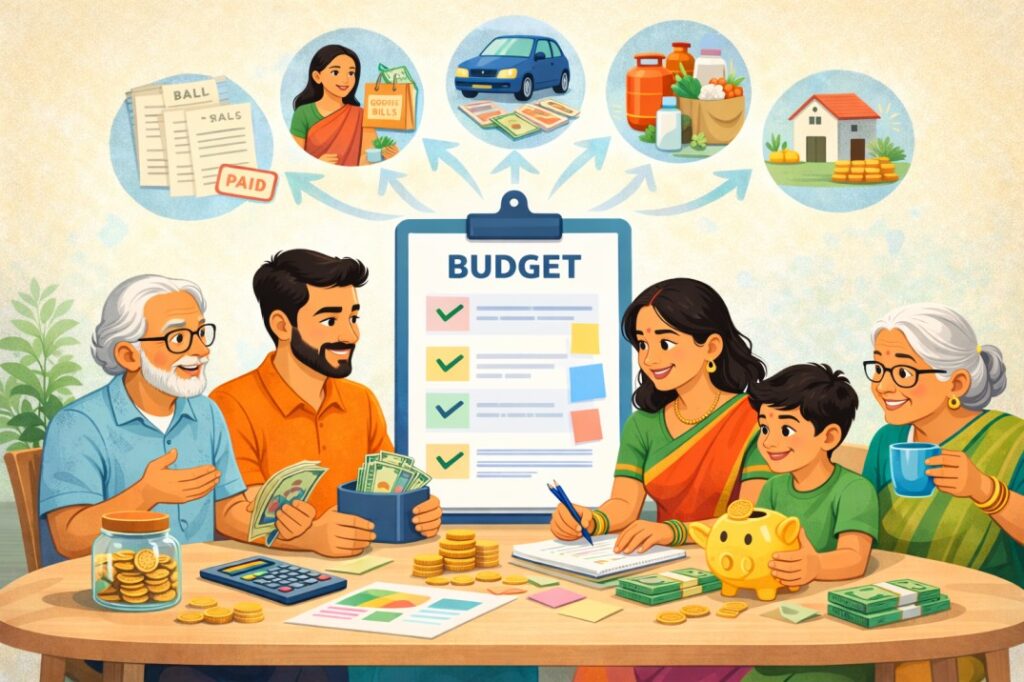
In India, joint families are still very common, especially in small towns and traditional households. Multiple generations — parents, married children, grandparents, and sometimes extended relatives — often live under the same roof and share financial responsibilities.
While joint families provide emotional support and shared living benefits, managing household finances can become complicated. When many people contribute to and spend from the same household budget, misunderstandings can arise easily.
Expenses in joint families are also naturally higher. Groceries, electricity, medical costs, education fees, social events, and festivals all add up quickly. Without proper planning, it becomes difficult to track spending and ensure fairness among family members.
However, joint family budgeting does not have to be stressful. With the right structure, clear communication, and simple financial rules, families can manage shared expenses smoothly.
In this article, we will explore how Indian joint families can plan monthly budgets effectively while avoiding financial confusion and conflicts.
Personal Experience
“Growing up in a joint family, I saw how difficult it was to track expenses when many people contributed money but no one maintained a clear budget.”
“Once we started listing household expenses and discussing them together every month, managing money became much easier and misunderstandings reduced significantly.”
Understanding the Financial Structure of Joint Families
Joint families usually have multiple income sources and shared expenses.
Typical structure:
| Category | Example |
|---|---|
| Income Sources | Salaries, business income, pensions |
| Shared Expenses | Groceries, electricity, house maintenance |
| Individual Expenses | Personal shopping, transport, entertainment |
The challenge is maintaining balance between shared costs and personal spending.
Benefits of Budget Planning in Joint Families
Creating a proper budget offers several advantages.
Financial Transparency
Everyone understands how money is used.
Fair Contribution
Working members can contribute based on their income.
Better Expense Control
Unnecessary spending becomes easier to identify.
Stronger Financial Security
Savings and emergency funds become possible.
If your family is just starting financial planning, explore this guide on personal finance planning at
https://savewithrupee.com/the-only-money-system-an-indian-family-needs-simple-sustainable-stress-free/
Step-by-Step Guide to Planning a Joint Family Budget
A structured approach helps avoid confusion.
Step 1: Identify Total Household Income
List all income sources in the household.
Example:
| Income Source | Amount |
|---|---|
| Son’s Salary | ₹50,000 |
| Daughter-in-law Salary | ₹30,000 |
| Father’s Pension | ₹15,000 |
| Family Business | ₹20,000 |
| Total Income | ₹1,15,000 |
Knowing total income helps set realistic spending limits.
Step 2: List All Shared Household Expenses
Shared expenses are costs that benefit the entire household.
Example:
| Expense | Monthly Cost |
|---|---|
| Groceries | ₹18,000 |
| Electricity | ₹5,000 |
| Gas | ₹2,000 |
| House Maintenance | ₹3,000 |
| Medical Expenses | ₹4,000 |
| Total | ₹32,000 |
These expenses should be covered by the household budget first.
Step 3: Separate Individual Expenses
Individual spending should be tracked separately.
Examples:
- Personal shopping
- Mobile bills
- Transport
- Entertainment
This prevents confusion about who is responsible for which expense.
Step 4: Decide Contribution Method
There are several ways families divide expenses.
Equal Contribution Method
All earning members contribute the same amount.
Example:
| Member | Contribution |
|---|---|
| Son | ₹10,000 |
| Daughter-in-law | ₹10,000 |
| Brother | ₹10,000 |
This method is simple but may not be fair if incomes differ.
Income Percentage Method
Contributions are based on income percentage.
Example:
| Member | Income | Contribution % |
|---|---|---|
| Son | ₹50,000 | 45% |
| Daughter-in-law | ₹30,000 | 27% |
| Business income | ₹20,000 | 18% |
| Pension | ₹15,000 | 10% |
This system is often more balanced.
Step 5: Create a Household Expense Fund
Many joint families use a common household fund.
Process:
- Each earning member contributes monthly
- Expenses like groceries and utilities are paid from this fund
Example:
| Category | Amount |
|---|---|
| Household fund contribution | ₹35,000 |
| Savings fund | ₹10,000 |
| Emergency fund | ₹5,000 |
This method simplifies expense tracking.
Step 6: Build a Family Emergency Fund
Large families often face unexpected expenses such as medical bills or home repairs.
Financial experts recommend keeping 3–6 months of household expenses saved.
Learn more about building an emergency fund here:
https://savewithrupee.com/emergency-fund-for-indian-families-how-much-you-really-need-where-to-keep-it-savewithrupee/
Step 7: Plan for Festivals and Family Events
In India, festivals and social functions can significantly increase expenses.
Examples:
- Weddings
- Diwali celebrations
- Religious functions
- Family travel
Planning these expenses early prevents financial pressure.
Comparison of Joint Family Budget Systems
| Method | Transparency | Fairness | Ease of Use |
|---|---|---|---|
| Equal Contribution | Medium | Medium | Easy |
| Income Percentage | High | High | Medium |
| Single Family Fund | High | High | Easy |
The household fund method works best for many joint families.
Real-Life Example: A Six-Member Joint Family
Consider a family with two working members and one pension income.
Income
| Source | Amount |
|---|---|
| Son | ₹45,000 |
| Daughter-in-law | ₹35,000 |
| Father’s Pension | ₹12,000 |
| Total | ₹92,000 |
Monthly Budget
| Category | Amount |
|---|---|
| Groceries | ₹16,000 |
| Utilities | ₹6,000 |
| Education | ₹8,000 |
| Medical | ₹4,000 |
| Miscellaneous | ₹6,000 |
| Savings | ₹10,000 |
Remaining income can be used for personal expenses and future investments.
Common Budgeting Mistakes in Joint Families
No Expense Tracking
Without tracking, spending quickly increases.
Unclear Financial Responsibilities
Everyone should know what they are responsible for.
Ignoring Emergency Savings
Unexpected expenses can disrupt finances.
Avoiding Financial Discussions
Open communication prevents misunderstandings.
Expert Tips for Joint Family Budget Management
Hold Monthly Budget Meetings
Short discussions help review expenses.
Use Shared Expense Tracking
A notebook or spreadsheet works well.
Encourage Responsible Spending
Everyone should understand household financial limits.
Build Additional Income Sources
Extra income strengthens financial security.
Explore realistic options here:
Learn more in our guide on passive income ideas at
https://savewithrupee.com/passive-income-ideas-in-india-2025-12-real-ways-to-earn-while-you-sleep/
Pros and Cons of Joint Family Budgeting
| Pros | Cons |
|---|---|
| Shared financial responsibility | Requires strong communication |
| Lower individual expenses | Can create confusion if not planned |
| Better support system | Large families may overspend |
| Easier emergency handling | Financial disagreements possible |
Frequently Asked Questions
1. How should earning members contribute in joint families?
Contributions can be equal or based on income percentage.
2. Is a common household fund necessary?
It is highly recommended because it simplifies shared expenses.
3. Should personal expenses be included in the family budget?
No, personal expenses should be separate.
4. How often should joint families review finances?
Once a month is usually sufficient.
5. What is the biggest financial challenge in joint families?
Lack of transparency about expenses.
6. Should pension income be included in household budgeting?
Yes, if it contributes to shared expenses.
7. Can joint families save more than nuclear families?
Yes, because shared living reduces individual expenses.
Conclusion
Budget planning in joint families may seem complex, but with clear communication and simple systems, it becomes manageable.
By identifying total income, listing shared expenses, creating a household fund, and planning savings, families can maintain financial harmony while meeting everyone’s needs.
Joint families have a strong advantage — shared responsibility. When this advantage is combined with smart budgeting, it can create financial stability for the entire household.
References
Reserve Bank of India – Household Financial Data
https://www.rbi.org.in
Securities and Exchange Board of India – Investor Education
https://www.sebi.gov.in
Economic Times Personal Finance Section
https://economictimes.indiatimes.com/wealth
Investopedia – Household Budget Planning
https://www.investopedia.com/budgeting-4689745
