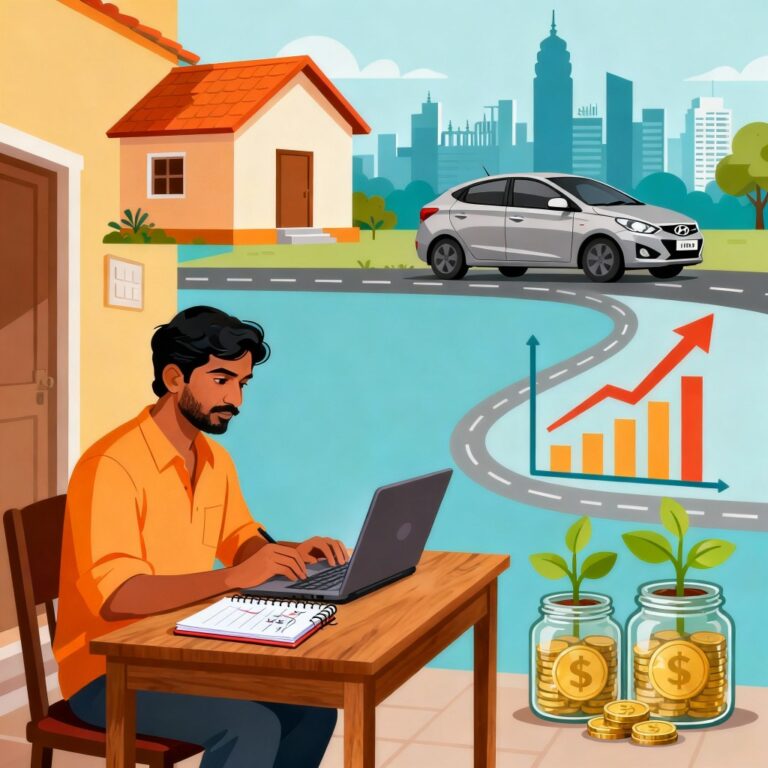

A real Indian story of how I built a simple monthly budget with actual numbers. Step-by-step roadmap, mistakes, myths, comparison tables, real-life stories, and practical budgeting lessons for Indian households.
How I Built a Simple Monthly Budget in India
(Real Example With Numbers, Mistakes, and Lessons That Changed My Life)
For years, I believed budgeting was only for people who were bad with money.
I was wrong.
I earned regularly.
I paid my bills on time.
Yet every month ended with stress, confusion, and the same question:
“Where did my salary go?”
If you are an Indian earning ₹15,000, ₹30,000, or even ₹1,00,000 a month and still feel broke — this article is written for you.
This is not theory.
This is my real Indian budgeting journey, with actual numbers, mistakes, and a system that finally worked.
Why Most Indians Struggle With Monthly Budgeting
In India, budgeting is emotional.
We don’t just manage money — we manage:
- Family expectations
- Festivals and functions
- Emergencies
- Guilt, pressure, and comparison
Nobody teaches us budgeting in school.
We learn it after making painful mistakes.
I wish I had followed some of the lessons I later shared in
financial advice I wish I followed 10 years earlier.
My Life Before Budgeting (The Reality)
Let me be honest.
Before budgeting:
- Salary came → confidence came
- Month progressed → money leaked
- Month-end → panic mode
No planning.
Only hoping.
That hope cost me years.
My Real Monthly Income (No Exaggeration)
At the time I started budgeting:
Take-home salary: ₹42,000 per month
No side income.
No investments.
Just one job and many responsibilities.
Step 1: Listing Every Expense (The Hard Truth)
I sat down with a notebook and wrote everything — without judgment.
My Monthly Expenses (Before Budgeting)
| Expense Category | Amount (₹) |
|---|---|
| House Rent | 12,000 |
| Groceries | 6,500 |
| Electricity + Water | 2,200 |
| Mobile + Internet | 1,200 |
| Transport | 3,000 |
| Eating Outside | 3,500 |
| Online Shopping | 2,800 |
| Family Support | 4,000 |
| Miscellaneous | 3,000 |
| Total | 38,200 |
Savings?
👉 Whatever was left (usually ₹0–₹1,000).
The Biggest Eye-Opener (Most Indians Miss This)
I wasn’t overspending on big things.
The real problem was small daily leaks.
₹99 here.
₹149 there.
₹299 “limited-time deal”.
This problem is deeply explained in
where most Indian households lose money without realising.
Step 2: Choosing Simplicity Over Fancy Apps
I didn’t use:
❌ Excel
❌ Complicated budgeting apps
❌ Foreign money systems
I used:
✔ Notebook
✔ Phone calculator
✔ Weekly review
Because simple systems survive.
The Budget Rule That Finally Worked for Me
I adapted a flexible Indian version of budgeting inspired by
the 50-30-20 rule of budgeting for Indians.
My Monthly Budget Structure
| Category | % | Amount (₹) |
|---|---|---|
| Needs | 60% | 25,200 |
| Savings | 25% | 10,500 |
| Wants | 15% | 6,300 |
| Total | 100% | 42,000 |
Step 3: Paying Myself First (Life-Changing Habit)
Earlier mindset:
Spend → Save if possible
New mindset:
Save → Spend what remains
The day salary came, I moved ₹10,500 to savings.
No ATM card.
No UPI.
No temptation.
This one habit connected strongly with
the day I realised my salary wasn’t the problem.
Real-Life Story #1: Ravi (₹30,000 Salary)
Ravi believed budgeting wouldn’t work on a small income.
After 6 months:
- ₹3,000 saved monthly
- ₹36,000 emergency fund
- No credit card stress
Income didn’t change.
Habits did.
Step 4: Expense Buckets (Indian Reality)
I divided expenses into three buckets:
Needs
Rent, groceries, bills, transport
Wants
Eating out, shopping, OTT, travel
Savings
Emergency fund, RD, SIP (later)
This method works even better for families, as explained in
why a family budget plan is important in India.
My Biggest Budgeting Mistake (Learn From This)
I became too strict.
No tea outside.
No snacks.
No enjoyment.
Result?
- Frustration
- One impulsive spending weekend
Lesson:
A budget should support life, not punish it.
Myth vs Reality (Indian Budgeting)
| Myth | Reality |
|---|---|
| Budgeting kills enjoyment | Budgeting creates guilt-free enjoyment |
| Only low earners budget | Rich stay rich by budgeting |
| Small savings don’t matter | Small leaks destroy big salaries |
| Budgeting is complicated | Simple systems work best |
Real-Life Story #2: Freelance Designer (Variable Income)
Her income changed every month.
She followed principles from
how to manage money when income changes every month.
Result:
- Used average income
- Built buffer fund
- No panic in low months
Step-by-Step Roadmap (Copy This)
Month 1
✔ Track all expenses
Month 2
✔ Categorise & adjust
Month 3
✔ Automate savings
Month 4
✔ Review & relax
Do vs Avoid Table
| Do | Avoid |
|---|---|
| Start simple | Complex apps |
| Review weekly | Daily micromanagement |
| Keep buffer | Zero-rupee planning |
| Involve family | Hiding finances |
Real-Life Story #3: Middle-Class Couple
They fought about money monthly.
After reading
how couples can budget without fights
they created a joint system.
Result:
- Transparency
- Zero money fights
- Shared goals
Comparison: Budgeted vs Non-Budgeted Life
| Area | No Budget | With Budget |
|---|---|---|
| Stress | High | Low |
| Savings | Accidental | Intentional |
| Enjoyment | Guilt | Freedom |
| Emergencies | Panic | Prepared |
Common Budgeting Mistakes Indians Make
- Ignoring annual expenses
- Forgetting festivals
- No emergency buffer
- Giving up too early
- Not tracking leaks
Expense tracking helped me deeply, as shared in
how I track every rupee I spend.
Editor’s Pick (One Habit That Matters Most)
👉 Weekly 10-minute money review
That’s it.
No obsession.
No stress.
Budgeting Checklist (Save This)
✔ Income noted
✔ Fixed expenses listed
✔ Variable expenses estimated
✔ Savings automated
✔ Emergency buffer added
✔ Monthly review date fixed
Pros & Cons of Monthly Budgeting
Pros
- Peace of mind
- Better savings
- Clear priorities
- Fewer money fights
Cons
- Needs discipline initially
- Takes 2–3 months to settle
Real-Life Story #4: Housewife Managing ₹25,000
She followed budgeting basics and:
- Reduced waste
- Saved ₹2,000 monthly
- Reduced family stress
FAQs (Answered Honestly)
1. Can I budget with ₹15,000 income?
Yes — it’s more important then.
2. Do I need Excel or apps?
No.
3. What if I overspend one month?
Adjust. Don’t quit.
4. Is budgeting different in India?
Yes — family & festivals matter.
5. When will I see results?
Within 30–90 days.
6. Should I invest without budgeting?
No.
7. Is budgeting stressful?
Only initially. Then it becomes freeing.
Real-Life Story #5: My Life After 1 Year
After one year:
- Emergency fund ready
- Started SIP
- No money anxiety
This journey connects deeply with
my personal journey from confusion to financial clarity.
Strong Call To Action
If you’re tired of wondering where your salary disappears every month, start here:
How to Save ₹5,000 Every Month Without Sacrifice ↗
Bookmark SaveWithRupee.com
where Indian money advice is practical, emotional, and real — built for real salaries, real families, and real life.
Author Insight
In my own experience managing monthly expenses in India, I realized that the biggest financial problems were not due to low income, but due to lack of planning. For example, when my monthly income was around ₹25,000, I often ended up spending almost everything without saving anything at the end of the month.”
“I started tracking my expenses daily using a simple notebook. Within one month, I noticed that small, unnecessary expenses like frequent online orders and unplanned spending were taking a large portion of my income.”
“By making small changes—like setting a fixed budget for groceries, limiting online purchases, and saving at least ₹2,000 at the beginning of each month—I was able to reduce financial stress and slowly build better control over my money.” “These are simple and practical methods that any Indian household can follow without needing complex financial knowledge.”
Research Sources
- Reserve Bank of India – Financial Reports
- SEBI Investor Education
- Economic Times – Personal Finance
- Investopedia – Budgeting & Finance Basics
Disclaimer: This article is based on personal experience and is for educational purposes only. It does not constitute financial, investment, or legal advice. Readers are advised to do their own research or consult a qualified professional before making any financial decisions.