
Irregular income is common in India. Learn a simple, stress-free system to manage money when your income changes every month—real stories, mistakes, tables, and a step-by-step roadmap.
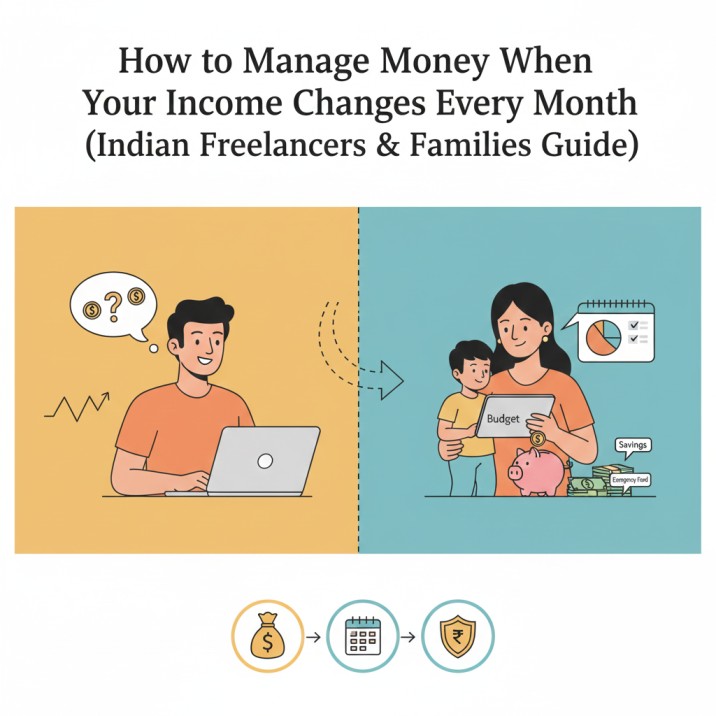
How to Manage Money When Your Income Changes Every Month
(A simple, sustainable system for Indian households with irregular income)
If your income changes every month, you’re not bad with money.
You’re just living a very Indian reality.
Freelancers.
Small business owners.
Sales professionals.
Commission-based workers.
Seasonal earners.
Even many salaried families with incentives and overtime.
One month feels comfortable.
Next month feels tight.
And the stress comes from one question:
“How do I plan money when I don’t know how much I’ll earn?”
This article is written exactly for that situation—no emojis, no jargon, no unrealistic rules.
Only practical, lived advice.
Who This Guide Is For
- Freelancers and gig workers
- Small business owners
- Commission-based employees
- Families with variable monthly income
- Anyone who says: “Some months are good, some months are bad”
My name is H. Suresh, founder of SaveWithRupee.com, based in Chennai, Tamil Nadu.
For over 10 years, I’ve studied Indian money behaviour—especially in households where income is not fixed.
Smarter Money. Better Life. One Rupee at a Time.
The Biggest Mistake People With Irregular Income Make
Here is the truth most people don’t want to hear:
They manage money like salaried employees.
That never works.
Irregular income needs a different system, not more discipline, not more stress.
Real-Life Story #1: Ravi, a Freelance Designer (Chennai)
Ravi earned:
- ₹25,000 one month
- ₹70,000 the next
- ₹18,000 the month after
His mistake:
- Spent like every month would be ₹70,000
Result:
- Anxiety
- Borrowing during low months
- No savings despite good income
What changed his life was not earning more, but changing how he planned.
Step 1: Calculate Your “Base Income” (Most Important Step)
If your income changes, never plan using your highest month.
Instead:
How to Calculate Base Income
- Look at last 6–12 months income
- Note the lowest consistent average
- That is your planning income
Example:
- Monthly income range: ₹20k–₹80k
- Safe base income: ₹25k–₹30k
Your life should run on your lowest dependable income.
Everything above that becomes bonus—not entitlement.
Step 2: Create a Bare-Minimum Budget (Survival First)
This budget covers only essentials:
- Rent / house EMI
- Groceries
- Electricity, water
- School fees
- Basic transport
- Mobile/internet
This budget must be fully covered by base income.
If not, lifestyle adjustment is required.
Related help:
Monthly Budget Plan for Family with ₹30,000 Income
Step 3: Separate Money Into Three Accounts (Critical for Irregular Income)
Most people mix everything. That creates confusion.
Use This Simple Structure
- Living Account
- Monthly expenses
- Only base income goes here
- Buffer Account
- Extra income
- Emergency fund
- Low months support
- Growth Account
- Investments
- Long-term savings
This separation alone reduces stress by 50%.
Related learning:
The Only Money System an Indian Family Needs
Real-Life Story #2: Meena, Home Baker (Irregular Orders)
Meena’s income depended on festival orders.
Before:
- High months wasted
- Low months stressful
After using buffer account:
- Festival income funded slow months
- No borrowing
- Mental peace returned
Step 4: Build a Bigger Emergency Fund Than Salaried People
This is non-negotiable.
If salaried people need 6 months,
irregular income earners need 9–12 months of expenses.
Why?
- Income gaps
- Delayed payments
- Seasonal slowdowns
Guide you should read carefully:
Emergency Fund – How Much Should an Indian Household Keep?
Step 5: Save and Invest Only From “Good Months”
This rule protects you from panic.
- Low month → survive
- Normal month → maintain
- Good month → save & invest
Never force SIPs based on your highest income.
If needed, keep SIP amount flexible.
Beginner-friendly investing:
SIP for Beginners – Start with ₹500
Real-Life Story #3: Arjun, Commission Sales Executive
Arjun fixed SIP based on best months.
During poor months:
- He stopped SIPs
- Felt guilty
- Lost discipline
After switching to:
- Small fixed SIP
- Extra investment only in good months
He stayed consistent and calm.
Step 6: Track Expenses During Low Months (Not High Months)
Most people track when income is high.
That’s wrong.
Track expenses when income is low.
That’s where leaks are visible.
My own turning point came from this habit:
How My Life Changed After Tracking My Expenses
Step 7: Control Lifestyle Inflation Ruthlessly
Irregular income + lifestyle inflation = permanent anxiety.
One good month does not mean:
- New phone
- Big shopping
- Long-term commitments
This connects deeply with:
Why Most Indians Never Feel Rich No Matter How Much They Earn
Common Mistakes People With Variable Income Make
- Planning life on best month
- No buffer fund
- Emotional spending in high months
- Guilt-driven saving in low months
- Comparing with salaried friends
These mistakes are behaviour-based, not income-based.
Related honesty:
The Day I Realised My Salary Wasn’t the Problem—My Habits Were
Myth vs Reality (Irregular Income Edition)
| Myth | Reality |
|---|---|
| Irregular income means no planning | Planning matters more |
| I’ll save when income stabilises | It may never stabilise |
| Fixed SIPs are mandatory | Flexibility is smarter |
| I earn less some months | You earn unevenly, not less |
Do vs Avoid Table
| Do | Avoid |
|---|---|
| Plan on lowest income | Planning on best month |
| Build big buffer | Living month-to-month |
| Separate accounts | Mixing all money |
| Flexible investing | Rigid commitments |
Simple 30-Day Roadmap
Week 1
- Calculate base income
- List bare-minimum expenses
Week 2
- Open buffer account
- Separate money flows
Week 3
- Start emergency fund
- Cancel unnecessary expenses
Week 4
- Begin small SIP
- Plan rules for good months
Helpful foundation:
7 Steps to Become Financially Independent
Checklist: Are You Managing Irregular Income Well?
- Base income identified
- Bare-minimum budget ready
- Buffer account active
- Emergency fund building
- Investments flexible
If you tick 3 or more, you are doing better than most.
Pros and Cons of Irregular Income (Honest View)
Pros
- Income growth potential
- Flexibility
- Upside during good months
Cons
- Uncertainty
- Requires discipline
- Emotional pressure
A system turns uncertainty into control.
Editor’s Pick (Most Important Advice)
“Irregular income is not the enemy.
Irregular planning is.”
FAQs
1. Can this system work with very low income?
Yes. It is more important when income is low.
2. Should I stop investing during low months?
Reduce, don’t eliminate—unless survival requires it.
3. What if income is zero some months?
That’s why buffer and emergency fund exist.
4. Do I need budgeting apps?
No. Awareness matters more than tools.
5. Should families plan together?
Yes. Especially with variable income.
6. Is saving possible with uncertainty?
Yes, with flexible rules.
7. What is the first step today?
Calculate your base income honestly.
Final Words
Irregular income does not mean irregular future.
It only means:
- You need a different system
- You must respect uncertainty
- You plan conservatively and act patiently
This approach helped me and many readers of SaveWithRupee.com move from anxiety to clarity.
Strong Call To Action
If this article felt like your life, don’t stop here.
Start with this practical guide:
How to Save Money on a Small Salary (₹10,000–₹20,000)
Bookmark SaveWithRupee.com
where Indian money advice is practical, calm, and real.
Smarter Money. Better Life. One Rupee at a Time.
Author Insight
In my own experience managing monthly expenses in India, I realized that the biggest financial problems were not due to low income, but due to lack of planning. For example, when my monthly income was around ₹25,000, I often ended up spending almost everything without saving anything at the end of the month.”
“I started tracking my expenses daily using a simple notebook. Within one month, I noticed that small, unnecessary expenses like frequent online orders and unplanned spending were taking a large portion of my income.”
“By making small changes—like setting a fixed budget for groceries, limiting online purchases, and saving at least ₹2,000 at the beginning of each month—I was able to reduce financial stress and slowly build better control over my money.” “These are simple and practical methods that any Indian household can follow without needing complex financial knowledge.”
Research Sources
- Reserve Bank of India – Financial Reports
- SEBI Investor Education
- Economic Times – Personal Finance
- Investopedia – Budgeting & Finance Basics
Disclaimer: This article is based on personal experience and is for educational purposes only. It does not constitute financial, investment, or legal advice. Readers are advised to do their own research or consult a qualified professional before making any financial decisions.