
Why even high-income Indians feel broke? Discover real reasons, mindset traps, lifestyle inflation, family pressure & a step-by-step roadmap to finally feel financially secure.
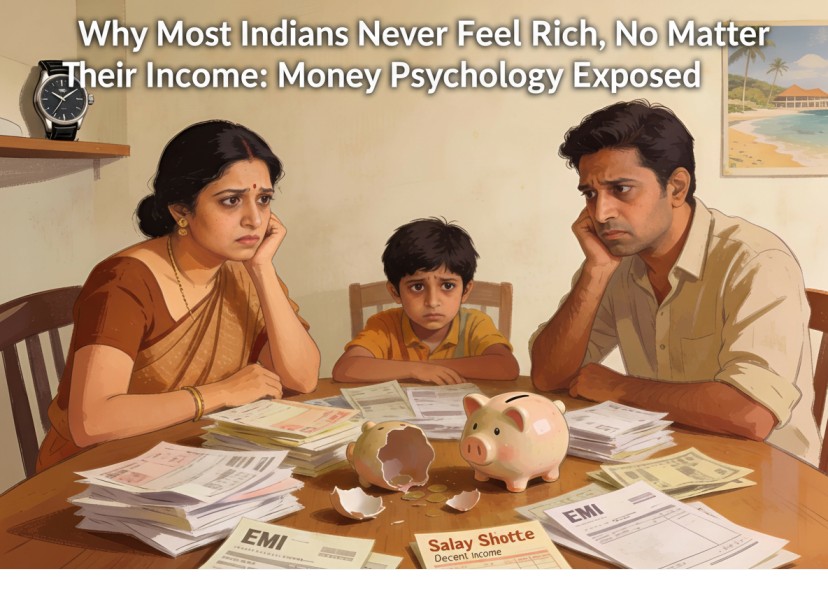
😔 Why Most Indians Never Feel “Rich” No Matter How Much They Earn
Have you ever noticed this strange truth?
👉 Someone earning ₹25,000/month feels broke.
👉 Someone earning ₹75,000/month still feels stressed.
👉 Someone earning ₹2 lakh/month says, “Bas thoda aur ho jaye…”
Yet on paper, incomes are rising.
So why do most Indians never feel rich, no matter how much they earn?
This article is not about motivation quotes or “earn more money” gyaan.
This is about real Indian money psychology, family pressure, lifestyle inflation, silent comparisons, and emotional money wounds that keep us feeling poor even when we aren’t.
I’ll share real-life Indian stories, practical tables, myths vs reality, mistakes to avoid, and a clear roadmap to finally feel financially secure — not just look rich.
🧠 What Does “Feeling Rich” Actually Mean?
Before we go deeper, let’s clear one big confusion.
Feeling rich ≠ earning more money
Feeling rich means:
- 😌 Peace of mind
- 🛌 Good sleep at night
- 🏠 Control over expenses
- 🛡️ Emergency safety
- ⏳ Freedom to say “no”
Most Indians chase income, but ignore emotional and structural security.
The Indian Money Reality (Hard Truth)
India is unique.
- Strong family obligations
- Social pressure to “settle early”
- Comparison culture
- No strong social security
- Rising cost of living
- Emotional spending tied to respect & status
Even high earners feel financially trapped.
📉 Real-Life Story #1: Ramesh (₹1.2 Lakh Salary, Zero Peace)
Ramesh works in an MNC in Bengaluru.
- Salary: ₹1.2 lakh/month
- Home loan EMI: ₹42,000
- Car EMI: ₹18,000
- Parents support: ₹15,000
- Lifestyle expenses: ₹25,000
Savings left: Almost nothing
He once told me:
“On paper I look successful, but one medical emergency can destroy me.”
Ramesh earns well, but owns nothing truly.
🔄 Reason #1: Lifestyle Inflation Eats Every Salary Hike
This is the biggest silent killer.
Every time income increases:
- Bigger house
- Better phone
- New car
- Costlier school
- More subscriptions
Income vs Lifestyle Comparison
| Income Level | Lifestyle Choice | Result |
|---|---|---|
| ₹30k | Basic life | Some savings |
| ₹60k | EMI starts | Stress |
| ₹1L+ | Status life | Anxiety |
💡 Money grows, but expenses grow faster.
👨👩👧 Reason #2: Family Responsibilities Without Planning
In India, income is rarely individual.
You pay for:
- Parents’ medical needs
- Siblings’ education
- Relatives’ emergencies
- Social functions
Real-Life Story #2: Sunita (Teacher, ₹45,000/month)
Sunita supports:
- Her parents
- Brother’s education
- Household expenses
She said:
“I don’t remember the last time I saved for myself.”
No fault here.
But lack of boundaries + lack of planning = permanent stress.
👉 Read:
Why Family Budget Planning Is Important
📱 Reason #3: Comparison Is the Thief of Peace
Social media has changed everything.
- Friend buys new car → insecurity
- Cousin buys flat → pressure
- Colleague upgrades phone → self-doubt
Real-Life Story #3: Amit (IT Professional)
Amit upgraded:
- Phone (because team had iPhones)
- Bike (office parking comparison)
- Clothes (LinkedIn image)
Now drowning in EMIs.
“I didn’t even enjoy these purchases.”
🧾 Reason #4: No Clear Financial System
Most Indians:
- Don’t track expenses
- Don’t know net worth
- Don’t have emergency fund
- Don’t invest consistently
Money comes → money goes.
👉 Start here:
How My Life Changed After Tracking My Expenses
💳 Reason #5: Easy Credit Feels Like Wealth
Credit cards, BNPL, personal loans.
They create a fake feeling of richness.
Real-Life Story #4: Neha (Marketing Executive)
Neha earned ₹70k/month.
But had:
- ₹3.5 lakh credit card debt
- ₹12k minimum dues
She said:
“I was living in future money.”
👉 Must read:
Credit Card Debt in India – Smart Payoff Plan
🧠 Myth vs Reality (Indian Edition)
| Myth ❌ | Reality ✅ |
|---|---|
| High income = rich | Control = rich |
| EMI is normal | EMI is delayed pain |
| Saving later is fine | Time is everything |
| Status brings respect | Stability brings respect |
🧍♂️ Reason #6: No Emergency Buffer
One emergency can:
- Wipe savings
- Create debt
- Destroy confidence
Real-Life Story #5: Mahesh (Freelancer)
COVID hit.
No emergency fund.
Had to sell gold.
“That day I realized, I was never rich.”
👉 Learn:
Emergency Fund – How Much Do You Need?
🚫 Common Money Mistakes Indians Make
- ❌ Saving after spending
- ❌ Buying liabilities early
- ❌ Ignoring insurance
- ❌ Mixing emotions with money
- ❌ Not investing consistently
👉 Related:
5 Money Mistakes Indians Make in Their 20s
✅ Do vs Avoid Table
| Do ✅ | Avoid ❌ |
|---|---|
| Track every rupee | Guessing expenses |
| Build emergency fund | Depending on loans |
| Invest early | Waiting for “right time” |
| Set boundaries | Social pressure spending |
🪜 Step-by-Step Roadmap to Finally Feel Rich
Step 1: Define “Enough”
Stop chasing infinity.
Step 2: Track Expenses (30 days)
Awareness creates control.
👉 Tool guide:
Best Free Budgeting Apps in India
Step 3: Build Emergency Fund (6 months)
Your real wealth shield.
Step 4: Kill Bad EMIs
Start with credit cards.
Step 5: Automate SIPs
Even ₹500 matters.
👉 Beginner guide:
SIP for Beginners – Start with ₹500
Step 6: Increase Income (Skill-Based)
Not hustle burnout.
📊 Feeling Rich vs Looking Rich (Comparison Table)
| Aspect | Looking Rich | Feeling Rich |
|---|---|---|
| Lifestyle | High | Balanced |
| Sleep | Disturbed | Peaceful |
| Savings | Low | Growing |
| Freedom | Limited | High |
🧾 Checklist: Are You Actually Financially Secure?
✔ Emergency fund ready
✔ No high-interest debt
✔ Monthly investing
✔ Insurance coverage
✔ Clear money goals
If you tick 3+, you’re richer than you think.
👍 Pros & Cons of Indian Money Mindset
Pros
- Family support
- Community strength
- Long-term thinking
Cons
- Emotional spending
- Comparison pressure
- Late financial planning
🏆 Editor’s Pick (Most Important Advice)
“Don’t increase lifestyle until your peace increases.”
Read this personal journey:
My Journey from Confusion to Financial Clarity
❓ FAQs (People Also Ask)
1. Why do high earners feel broke?
Because expenses, EMIs, and obligations rise faster than income.
2. How much income is enough to feel rich in India?
There is no number. Control matters more.
3. Is lifestyle inflation bad?
Not if planned. Dangerous if unconscious.
4. Can saving small amounts really help?
Yes. Consistency beats amount.
5. Is buying a house early a mistake?
Not always, but EMI without buffer is risky.
6. How to stop comparing with others?
Track your net worth, not their lifestyle.
7. What’s the first step to financial peace?
Emergency fund + expense tracking.
❤️ Final Words: You Are Not Behind
Most Indians don’t feel rich because nobody taught us how money really works.
Not in school.
Not at home.
Not at work.
But the good news?
👉 You don’t need to earn more to feel rich.
👉 You need clarity, control, and consistency.
🚀 Strong Call To Action (CTA)
If this article hit you emotionally, don’t scroll away.
👉 Start with this simple guide:
7 Steps to Become Financially Independent
And bookmark SaveWithRupee.com — where money advice is Indian, practical, emotional, and real.
Because feeling rich is not about money.
It’s about freedom. 💚
Author Insight
In my own experience managing monthly expenses in India, I realized that the biggest financial problems were not due to low income, but due to lack of planning. For example, when my monthly income was around ₹25,000, I often ended up spending almost everything without saving anything at the end of the month.”
“I started tracking my expenses daily using a simple notebook. Within one month, I noticed that small, unnecessary expenses like frequent online orders and unplanned spending were taking a large portion of my income.”
“By making small changes—like setting a fixed budget for groceries, limiting online purchases, and saving at least ₹2,000 at the beginning of each month—I was able to reduce financial stress and slowly build better control over my money.” “These are simple and practical methods that any Indian household can follow without needing complex financial knowledge.”
Research Sources
- Reserve Bank of India – Financial Reports
- SEBI Investor Education
- Economic Times – Personal Finance
- Investopedia – Budgeting & Finance Basics
Disclaimer: This article is based on personal experience and is for educational purposes only. It does not constitute financial, investment, or legal advice. Readers are advised to do their own research or consult a qualified professional before making any financial decisions.